


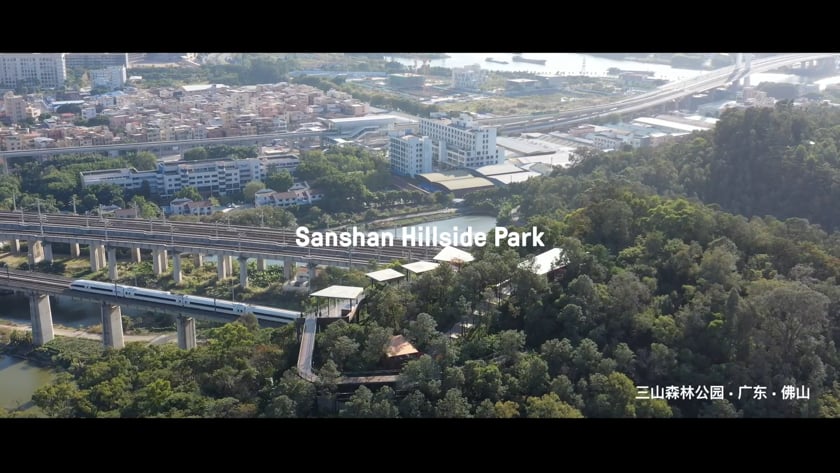
The Pearl River Delta has undergone a dramatic transformation over the past four decades, evolving from farmland to a global manufacturing and technology powerhouse. Amid the frenetic pulse of this sprawling megalopolis of 86 million people, Sanshan Hillside Park stands as a mountaintop oasis.
Envisioned as New Town’s Central Park, the design embraces the very infrastructure that defines the region’s growth by utilizing Sanshan Mountain’s existing topography and ecosystem to create thematic zones. A wilderness belt encircles the mountain, protecting sensitive natural slopes, while a web of trails provides access to park amenities, including a library, café, elevated canopy walk, and water gardens. The space beneath the high-speed rail bridge has been reclaimed as a public fitness area, and a hilltop observation deck offering visitors the unique experience of “train spotting.” Clever landscaping and strategic vegetation placement mitigate transportation noise.
Aligning with “Sponge City” guidelines, pond drainage swales and rain gardens improve water quality and reduce flood risk. The “Resiliency Edge” connects the park to urban neighborhoods through a system of lakes, waterways, and seasonal rain gardens, doubling as drainage infrastructure.
The park’s commitment to preservation, reuse, and enriching cultural spaces provides a refuge where health and wellness are prioritized. Here, visitors can truly appreciate sweeping views of the region while enjoying a respite from urban life.
King Salman Park
The largest urban public park ever built, King Salman Park is a defining element of Saudi Vision 2030—an ambitious effort to transform Riyadh into a more livable, sustainable, and globally competitive city. Envisioned as the “Green Lung of Riyadh,” the 16.6-square-kilometer park spans seven times the size of London’s Hyde Park and five times that of New York’s...
Pazhou South Waterfront Park
This four-hectare urban waterfront park is a pilot project in the landscape renovation of Hungpuchong River, setting a high standard for riverfront public space in Guangzhou. The new public realm aims to connect the surrounding neighborhood and transportation hub to the river, bringing people back to the water’s edge.
The park activates the waterfront a...
Xingfa Quarry Park
Just north of Beijing, between the Great Wall and Yanqi Lake, the Xingfa Cement Plant once fueled China’s construction boom, operating for over two decades before its 2015 closure under the National Air Quality Action Plan. Today, an adjacent quarry that once provided raw materials has been remediated as a 107.5-hectare terraced park that anchors an accompanyi...
Resonant Memory: One October Memorial
Inspired by the shared love of country music that brought people from all over the world together for the Route 91 Music Festival, Resonant Memory is based on the shape of an acoustic guitar. The design makes particular use of the instrument’s sound hole as a recurring motif to represent absence, honoring the lives lost on October 1, 2017, in Las Vegas, Nevada...