

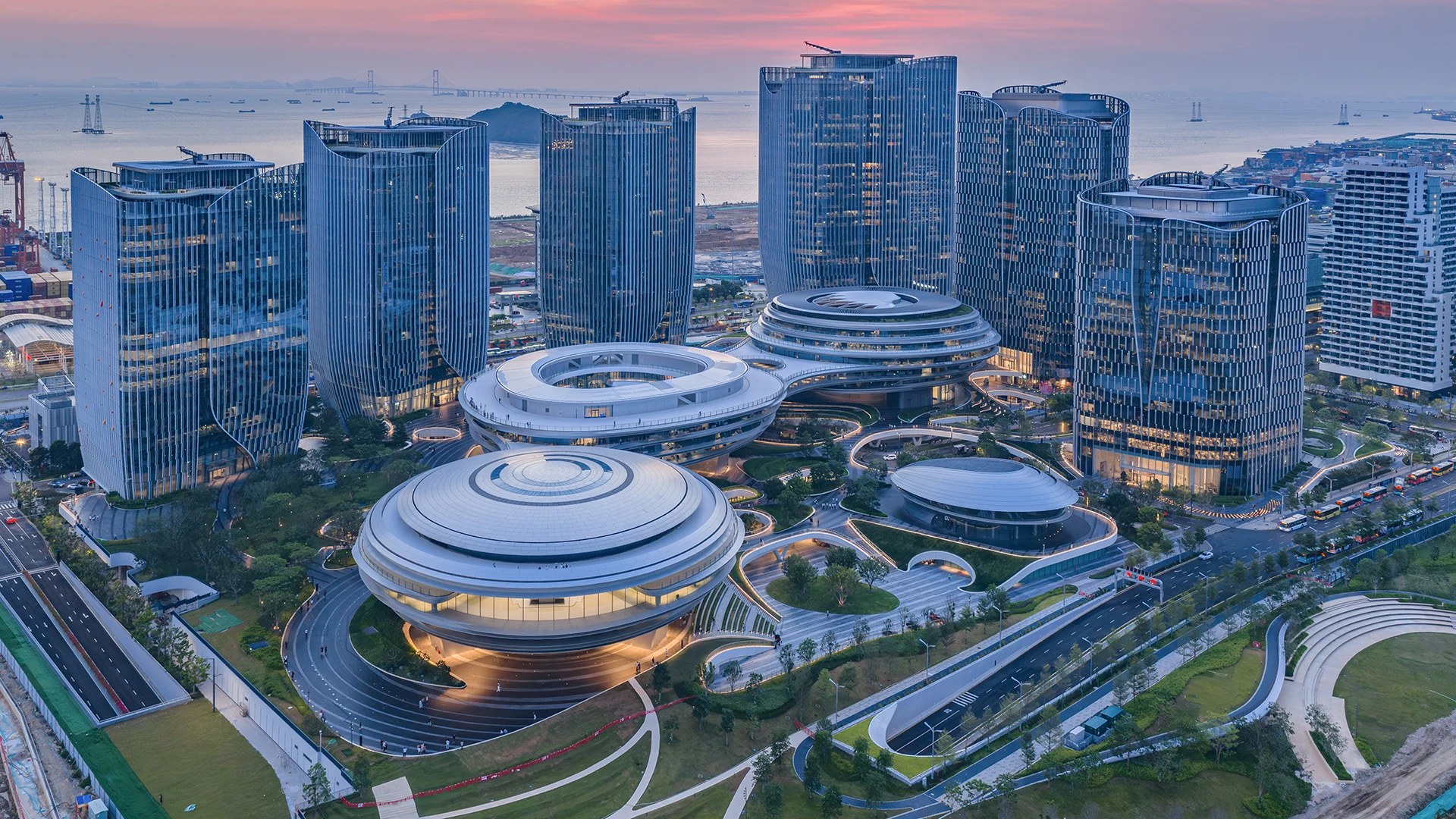


Spanning nearly two million square meters on a peninsula sheltering Shenzhen’s Qianhai Bay, Tencent’s new headquarters serves as the domestic anchor for the tech giant’s global operations in China. Once completed, it will be one of the largest tech campuses in the world, roughly the size of Manhattan.
The campus is entirely car-free. Designed by an international consortium of architects and engineers, the neighborhood is united by a complex open space network developed by SWA—split across three levels and knitting together residential, educational, office, research, and public facilities from end to end. A concealed monorail runs underground, enabling quick travel across campus. At ground level, pedestrian paths offer direct connections between buildings. Above, a network of elevated landscape decks, the campus’s defining spatial feature, links major structures with planted walkways, evoking the feeling of moving across a canopy. Along the bay, mangrove forests help buffer storm surge.
An extraordinary diversity of building sizes, typologies, and landscape treatments is integrated throughout the development, ranging from one to 30 stories and framing panoramic views of the bay, city, and broader Pearl River delta. Once completed, the campus will accommodate up to 80,000 residents and workers. Organized into five blocks, design and construction are proceeding in phases, with initial community and office spaces opening in 2025 and overall completion anticipated in 2029.
Block 1: Conference Center
At the southernmost tip of the peninsula, a reflective, U-shaped structure anchors Tencent’s Shenzhen campus. Designed by NBBJ, the building’s two wings join at the south, offering views over the bay, before opening northward to receive visitors through a lush entry plaza.
The landscape establishes the building’s foundation while reaching outward to the surrounding coastal park. Four distinct spaces unfold across the site: the entry plaza, a sheltered courtyard, a grand overlook, and a roof garden. The plaza draws visitors through dense planting and shaded arrivals. The courtyard fosters gathering between the two wings. The overlook frames the bay in full, and a roof garden captures stormwater while extending the green canopy skyward.
Block 2: Innovation Center
The largest plot of Tencent’s Shenzhen Headquarters campus, Block 2 unfolds as its innovation center and mixed-use hub. A pedestrian corridor bisects the site, connecting the development to the wider campus while gardens extend outward between every cluster of buildings, ensuring that offices, hotel, and residences alike are rooted in greenery.
The landscape serves as the structural skeleton of the plot: a three-dimensional system that rises from sunken gardens carved beneath the TOD hub and scales the terraces and skybridges above. Hexagonal paving — a geometric motif carried across the campus from block to block — traces the skybridges and ground-level plazas. Building drop-offs are laid in patterns reminiscent of a cell’s structural makeup. The central park is the site’s “forest lung,” a layered canopy where smart landscapes respond to human presence. The gaming pavilion opens to a lawn with terraced seating oriented for presentations and gathering.
Block 3: Headquarters
At the center of the two-million-square-meter campus development, Tencent’s Headquarters blooms in Block 3, expanding in a helix form—a symbol of the company’s meteoric growth. The executive offices extend through a swirl of four interconnected towers designed by Büro Ole Scheeren, cascading down through planted terraces to create a layered open-air plaza dubbed the “vortex incubator” at its center. This vortex form is a nod to the origin of Tencent’s technology empire and the structure of DNA, mirroring its contents as a home to recreational spaces, collaboration rooms, and a health and fitness center.
Spiral and hexagonal patterns extend outward in sweeping petal-form gardens and plazas that draw visitors in, flanked by teardrop-shaped R&D facilities—each punctured by circular oculi that carve out interior courtyards.
Block 4: Research
Extending the biomorphic forms of the network of landscape decks skyward, a trio of “cloud buildings” designed by MAD Architects house office spaces anchor the Tencent Headquarters Block 4. Inspired by lenticular cloud formations, their terraced façades echo and connect with the undulating pathways below. Throughout, the landscape design is inspired by naturally occurring flow patterns—for instance, vibrations moving through water and the oblong curves of plant cells. The green carpet expands mid-air across the terraces, supported by sponge water storage models, and continues below to multi-functional gardens, plaza, and promenades.
Rising above the cloud buildings, seven office towers designed by NBBJ evoke flower buds in mid-bloom, two of them joined by a landscaped sky bridge, and feature rooftop gardens that offer sweeping views of the city and the Pearl River estuary.
Block 5: Community Hub
At the heart of the campus’ recreational and civic life, Block 5 features two schools designed by Perkins&Will—one a public K–9, the other a private K–12—inspired by the modular form of clover leaves. The block also includes a community center, health clinic, athletic fields, and a central bus hub. Along its edges, family housing designed by MVRDV is arranged in stepped masses and interwoven among expansive public plazas, shaded playgrounds, and densely planted gardens, connecting seamlessly to a continuous, campus-length waterfront park along the bay.
Lake Park Business Center
The site design is charged with a strong geometric pattern formed through large swaths of native planting, decking, and sunken courts. A rectangular grid is enhanced by intersecting materials, textures, light, and shade. Subtle grade changes create opportunities for seat walls and sunken gardens. The intimate spaces that result provide for gathering, conversa...
Symantec Chengdu
SWA provided landscape design for Symantec’s research and development complex. The site was previously inactive and banal until SWA’s design reinvigorated the area, linking the building program and connecting the site to the larger city. The landscape design produces a “brocade,” weaving together the building and site program, and offering an oasis amid the de...
Roche Diagnostics
As the first manufacturing facility in Asia, Roche Diagnostics hopes to set a model for future projects in the region. Located in Suzhou, a city with a strong tradition of gardening, this flagship factory will not only meet Roche’s global standard, but will be infused with the spirit of the city’s gardens, distinguishing it from a stereotypical factory. A clea...
Poly Future City
As the first phase of a large development along a new subway line in Beijing, Poly Future City suggests what’s to come. A sleek sales center features an interactive landscape with water features punctuating its pavilions, which boast WiFi, heated seating, and power outlets, all solar-powered. For this temporary building and landscape, SWA took care to invest i...