


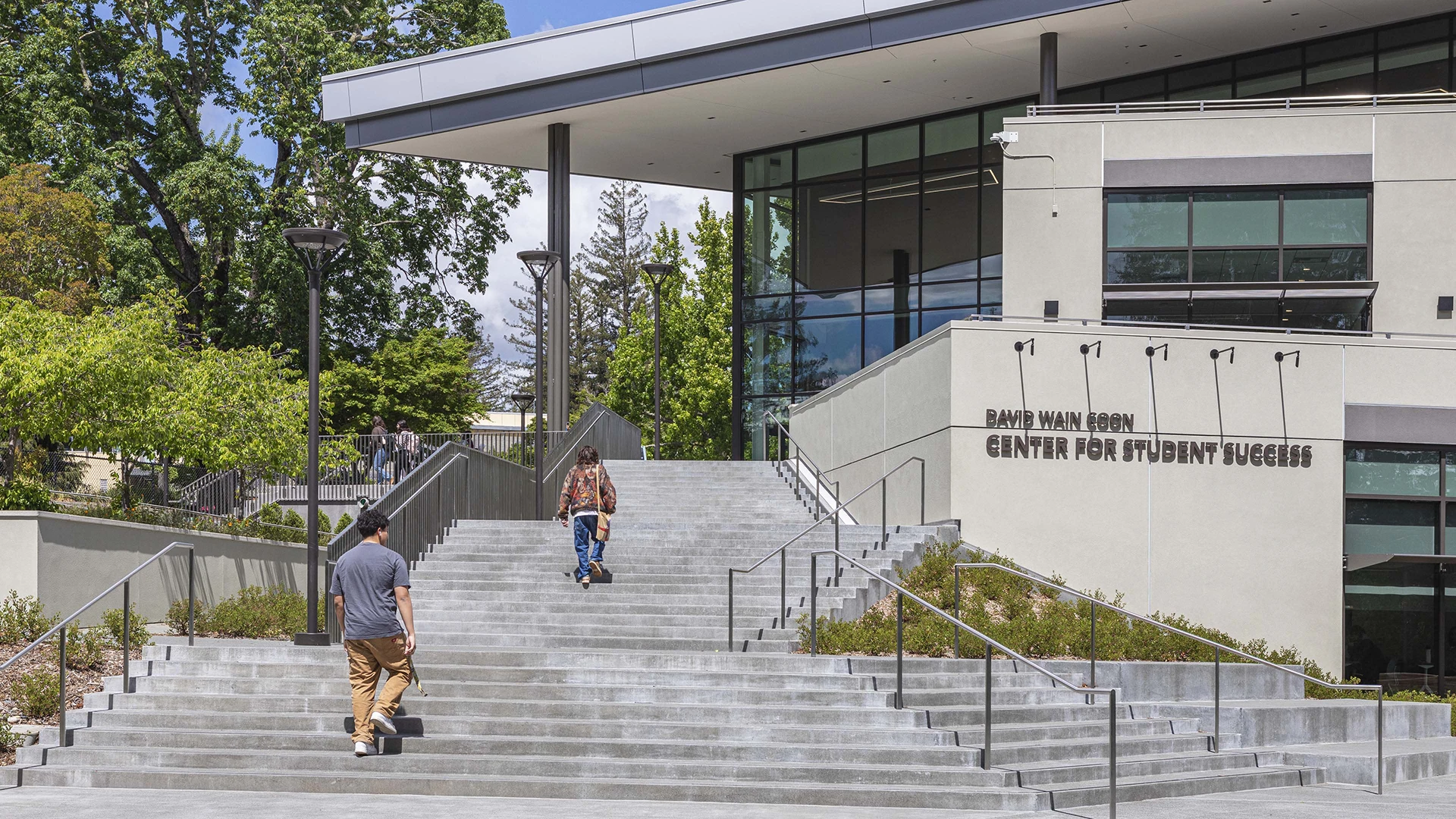


Named for the College of Marin’s former 13-year superintendent, the new Dr. David Wain Coon Center for Student Success serves as the campus centerpiece along College Avenue. In collaboration with architects Group 4 and HMC, the college’s new library and study center reimagines a previously unwelcoming campus edge by transforming it into an open and inviting arrival point. Previously a parking lot and loading dock, the new campus entrance is adorned with several specimen trees and generous vegetation along Corte Madera Creek. A curved walkway leads to the Center for Student Success, complemented by a social plaza and views to the campus and hills beyond. The building’s siting and form, including a series of outdoor terraces, is choreographed to feature views of Mount Tamalpais, Marin County’s landmark. The building and flanking grand stairs engage the campus’ topography by having entrances at both the lower Creekside level and the upper Campus Glade level.
Miwok Aquatic and Fitness Center
Nestled in Novato’s rolling Oak woodlands, the College of Marin’s Miwok Aquatic and Fitness Center provides Northern California with a new destination for aquatic training and competitions. Part of the College’s Indian Valley Campus, the center neighbors over 1,400 acres of open space preserves. ELS and SWA worked closely to lay out the site ...
Cañada College Kinesiology & Wellness
In collaboration with ELS, SWA designed a new landmark for Canada College: the Kinesiology & Wellness Center. The project replaced a windowless 1960s-era gym building and outdoor asphalt yard with the glassy new building and infinity pool deck on this hilltop campus with fantastic views. The project also created a new campus arrival and ceremonial overlo...
Northwest Vista College
Northwest Vista College is situated in the oak covered hills west of San Antonio, with beautiful views toward the city and surrounding valley. Previously the design team completed an extensive master plan that accommodated for the expansion of the college facilities to three times its current size. The design seeks to sensitively integrate the nearly 400,000 s...
RIT Global Village and Global Plaza
Global Village, a pedestrian-only infill neighborhood adjacent to Rochester Institute of Technology’s academic core, and its mixed-use centerpiece, Global Plaza, create a social heart for 17,200 students and 3,600 faculty and staff. The landscape architects and architects collaborated on an urban design that establishes multiple “crossroads” ...