


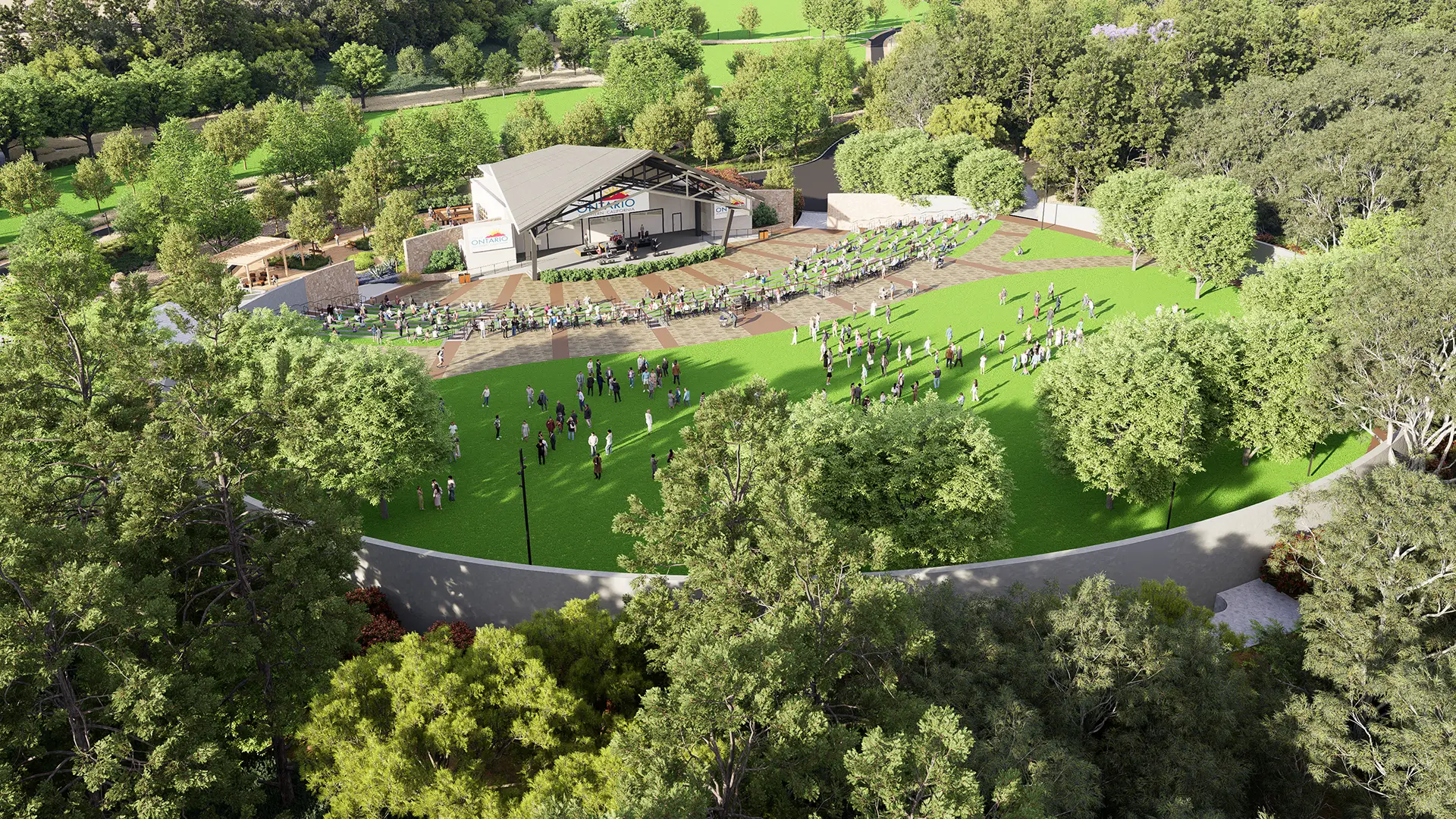


Dating back to the late 1800s, Ontario, California, has been an ideal destination for agriculture, boasting orange, peach, lemon, and walnut groves. With an economy now based in manufacturing, access to an international airport, and proximity to Los Angeles, Ontario’s population is predicted to double by 2035. In response to the growing community, Ontario Grand Park serves as an anchor for a developing part of the city, spanning over 340 acres and stretching a full mile longer than New York’s Central Park.
Drawing inspiration from the native flora and agrarian heritage, the Ontario Great Park Master Plan establishes a flexible framework to be realized over decades, responding to population growth. A tall canopy forest delineates the park’s perimeter, extending the canopy coverage from the neighboring streets. This network of much-needed shade frames the meadows and gardens within. A central arroyo serves as the drainage backbone for the park. A network of trails, including a major artery for bikes and pedestrians and smaller meandering paths, produces miles of ground to explore. As the surrounding neighborhoods grow, program elements can be added to the framework, as passive meadows transform into active lawns and programs evolve to serve the community’s needs.
Phase one of the park comprises the easternmost edge of the master plan, spanning 130 acres. A flexible 5,000-seat amphitheater, designed to host both ticketed events and impromptu performances, is centrally located within the phase. The venue neighbors a community farm barn and ties into the trails network. Three orchards are spaced throughout phase I, on the east and west perimeter, and in the center next to the barn. Active turf fields and rustic meadows follow the arroyo’s meandering path, offering flexible lawns for lounging and activities. SWA collaborated with a team of architects and engineers, including Bickel Group Architecture, to envision and deliver the new amphitheater, scheduled for completion in 2027.
Fernwood Avenue Park
The Fernwood Avenue Park represents a significant opportunity for the city to enhance the water quality and availability of groundwater for residents, while also offering public amenities. Equipped with four detention basins that capture water onsite and from the street, the project plays an important role in the community as a stormwater infiltration site. Th...
The Clearing: Sandy Hook Permanent Memorial
This project was designed to honor the 20 children and six educators who were slain on Dec 14, 2012 at Sandy Hook Elementary School. Designers Dan Affleck and Ben Waldo created a competition-winning design for a memorial space which is both open-ended and unifying in how it is experienced, honoring the full spectrum of emotions this tragedy evokes. They wanted...
Pazhou South Waterfront Park
This four-hectare urban waterfront park is a pilot project in the landscape renovation of Hungpuchong River, setting a high standard for riverfront public space in Guangzhou. The new public realm aims to connect the surrounding neighborhood and transportation hub to the river, bringing people back to the water’s edge.
The park activates the waterfront a...
Eucalyptus Society Garden
SWA’s design for this park, with its collegiate social atmosphere, offers a memorable place of natural respite that functions as green infrastructure.
Eucalyptus Society Garden project is located at the intersection of three science and innovation corridor axes in Guangzhou International Innovation City, including the core axis of the University City. B...