


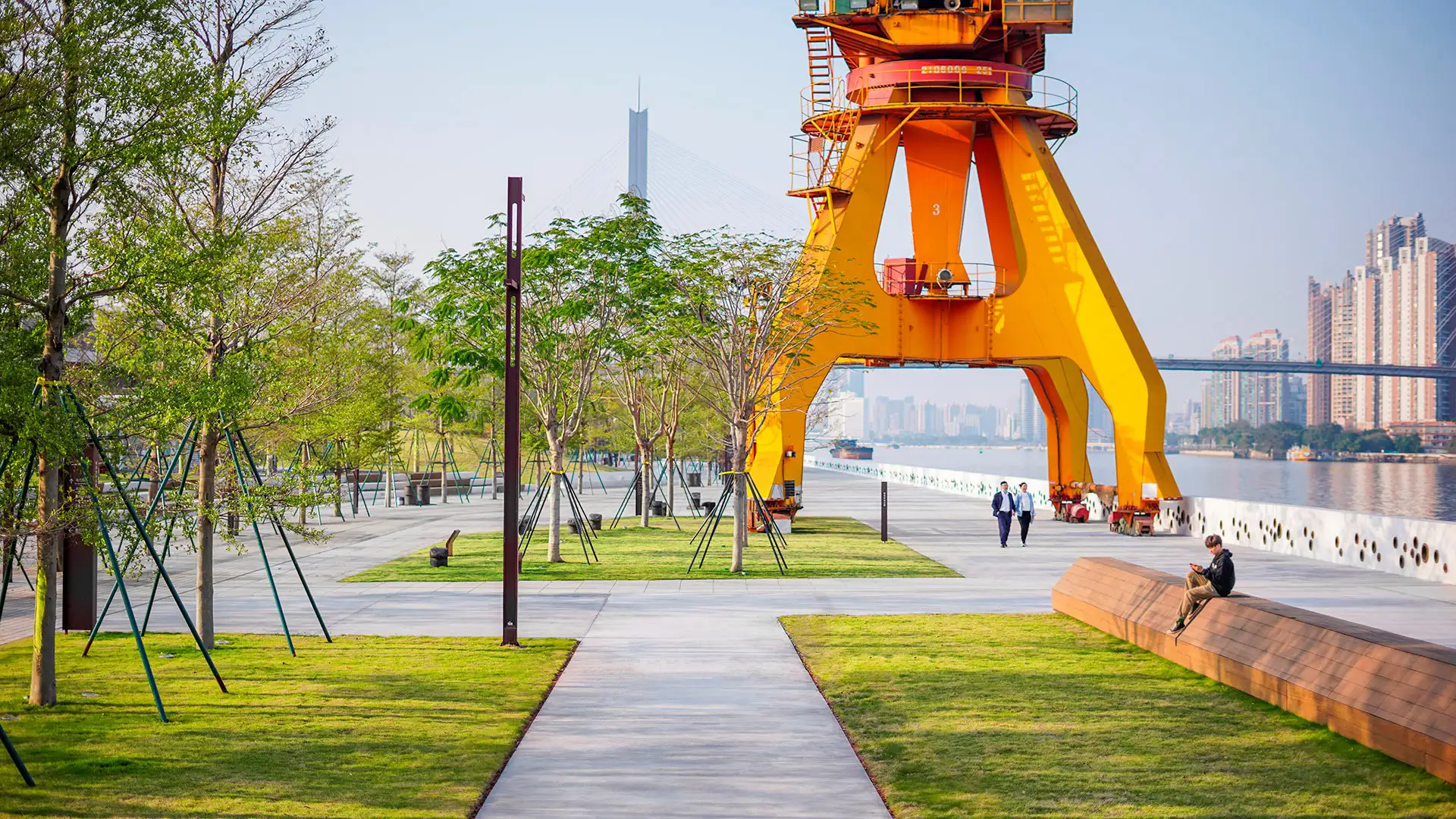


On the west bank of the Pearl River, the historic Guangzhou Shipyard has been transformed into a waterfront park that reconnects residents with the water while honoring over a century of industrial heritage. Once a Qing Dynasty fortress, the site became a shipyard in 1914 and grew into an almost 50-hectare complex—one of the earliest and most renowned in China—before the city relocated its shipbuilding industry to the suburbs in 2017. Alongside the adjacent Guangzhou Steel Factory (also designed by SWA) and the Guangzhou Paper Factory across the river, the district is now emerging as a dense urban core of housing, offices, schools, retail, and hotels.
Heritage preservation anchors the park’s identity. Three historic ship slipways, an original boat dock, and three cranes were retained and woven into the design, while industrial remnants found new life: hollowed-out ship parts became trash receptacles, bolts became benches, and gear cogs formed porthole-like openings along the flood wall. New amenities—slipway-shaped pavilions, sports fields, ship-themed playgrounds, and a pedestrian greenway—build on this layered history.
Environmental restoration was equally central. After developers capped the site’s contaminated soil, SWA introduced phytoremediation plantings—both local and adaptive species—to absorb residual pollutants, stabilize contamination, and cut costs by avoiding imported clean soil. More than 70 percent of the promenade uses permeable pavement, far exceeding Chinese policy requirements, while detention ponds, a grass swale, and rain gardens manage stormwater across the site.
Guangzhou Shipyard Park recasts an industrial legacy into a resilient, accessible riverside landscape—recognized with an Honor Award in the 2022 WLA Awards for Built Urban Design.
Hangzhou Grand Canal
For centuries, the Beijing-Hangzhou’s Grand Canal – a staggering 1,000 linear miles which remain the world’s longest man-made waterway – was a lifeline for commerce and communication. The water’s edge was necessary for trade, a logical place to live, and often a driver of innovation. However, as with many waterfronts globally, it eventually fell victim to the...
Hangzhou Hubin
West Lake, one of the world’s most romantic places and as familiar an icon as the Great Wall or the Forbidden City, has been designated by the United Nations as a World Cultural Heritage Site. As Hangzhou joined China’s burgeoning economy, HuBin Road, a multilane highway bordering the lake, grew out of scale and became a significant barrier to the la...
Aquatic Park & Pier Vision Study
The Aquatic Park and Pier Vision Study is a community-led effort examining new possibilities along San Francisco’s northern waterfront. Prompted by the need to replace the disintegrating Aquatic Park Pier — a historic, curvilinear structure that shelters shoreside water for swimmers and boaters — the Vision Study looks beyond the immediate boundaries of the Ma...
BoAi Lake
Located in Shishan Town, Foshan, the 136-hectare BoAi Lake site began as a freshwater reservoir before being subdivided into a patchwork of aquaculture fish ponds. This fragmentation broke hydrologic continuity, isolated habitats, and cut the public off from the water’s edge. Bounded by emerging mixed-use development to the north and preserved forest to ...