


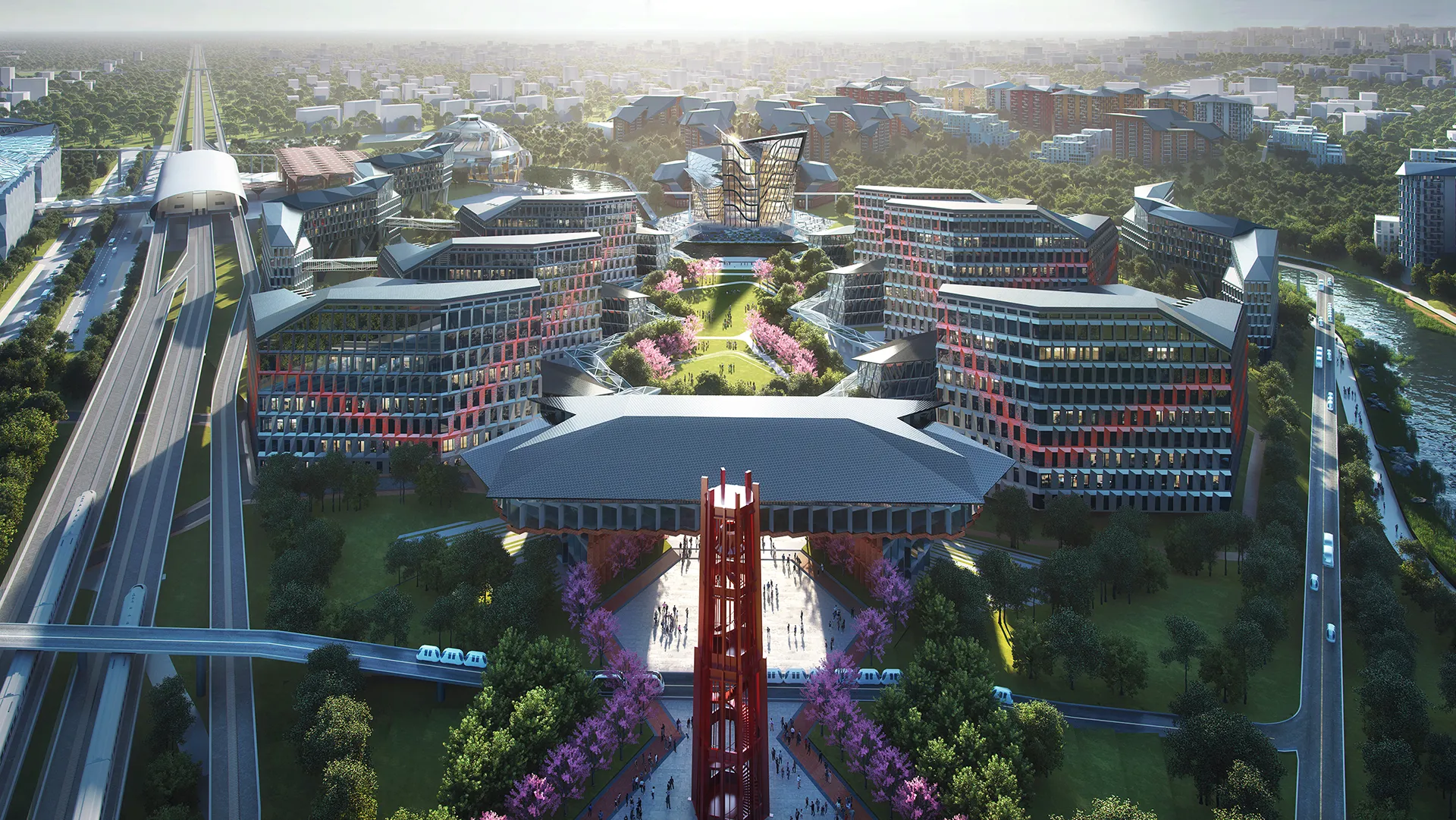


A key inland alternative to China’s coastal tech centers, Chengdu has emerged as a major science, technology, and manufacturing hub. As part of an international design competition for the city’s Hi-Tech Industrial Development Zone organized by a local investment group and the planning bureau, the Chengdu Future Science and Technology City is an achievable visionary model for a next-generation science city, blending business, residential, and academic ecosystems within a highly connected, landscape-driven framework. Spanning approximately 4.6 square kilometers, the district is a center for aerospace, high-end manufacturing, telecommunications, and advanced research, anchored by Chengdu Electronic University, Sichuan University, a national research laboratory, and a transit-oriented development linking Chengdu Tianfu International Airport with the city.
Organized around an adaptive hexagonal grid, the master plan establishes a powerful spatial order that allows for organic growth and flexibility over time. This planning framework integrates industry, housing, and academia, creating an integrated public realm, ensuring community through a continuous network of open spaces.
Landscape is the primary organizing element of the city, with more than 40% of the site dedicated to green space. A layered system of parks and ecological corridors weaves nature into the urban fabric, balancing ecological performance with social life. Automobiles are removed from the interior of the site, with conventional vehicles accommodated in perimeter garages. Within the city, pedestrian and bicycle networks are paired with an autonomous rapid transit system and autonomous pods, prioritizing human-scale movement and clean mobility. This car-free approach enables a calm, walkable environment that seamlessly integrates the built and natural realms, reinterpreting centuries-old urban and landscape precedents through a contemporary, future-oriented lens.
Guangzhou Axis District Planning
The Guangzhou Green Axis District Urban Design paved the way for new growth in one of China’s major metropolitan areas by bringing nature into the city, connecting people to the river and CBD, and providing a major park and open space for all ages. In the early 2000s, when the project commenced, Guangzhou was a rapidly growing city of approximately 8 million. ...
Beaumont Downtown Plan
Beaumont sits at the heart of Texas’s “Golden Triangle” and has recently been named a top travel destination and the “Cajun Capital of Texas,” with billions of dollars in new energy investment now flowing into the city. Yet despite this momentum and its historic architecture, downtown Beaumont has struggled to sustain vitality, at...
Lewis Avenue
In a city renowned for fantasy, the design of Las Vegas’ Lewis Avenue celebrates the local desert landscape and affirms the street as part of a real-world working district. It was one of the first projects to be implemented in Mayor Oscar B. Goodman’s 2000 Las Vegas Downtown Centennial Plan, aimed at revitalizing the historic downtown core. The City asked SWA,...
ARTIC – Anaheim Regional Transportation Intermodal Center
ARTIC, the new 16-acre Anaheim Regional Transportation Intermodal Center in Southern California, forms a seamless gateway from Anaheim to all of Orange County, spurring economic growth and community redevelopment throughout the region. The landscape design establishes a unique and identifiable image for the ARTIC Mixed-Use District by complementing the site’s ...