


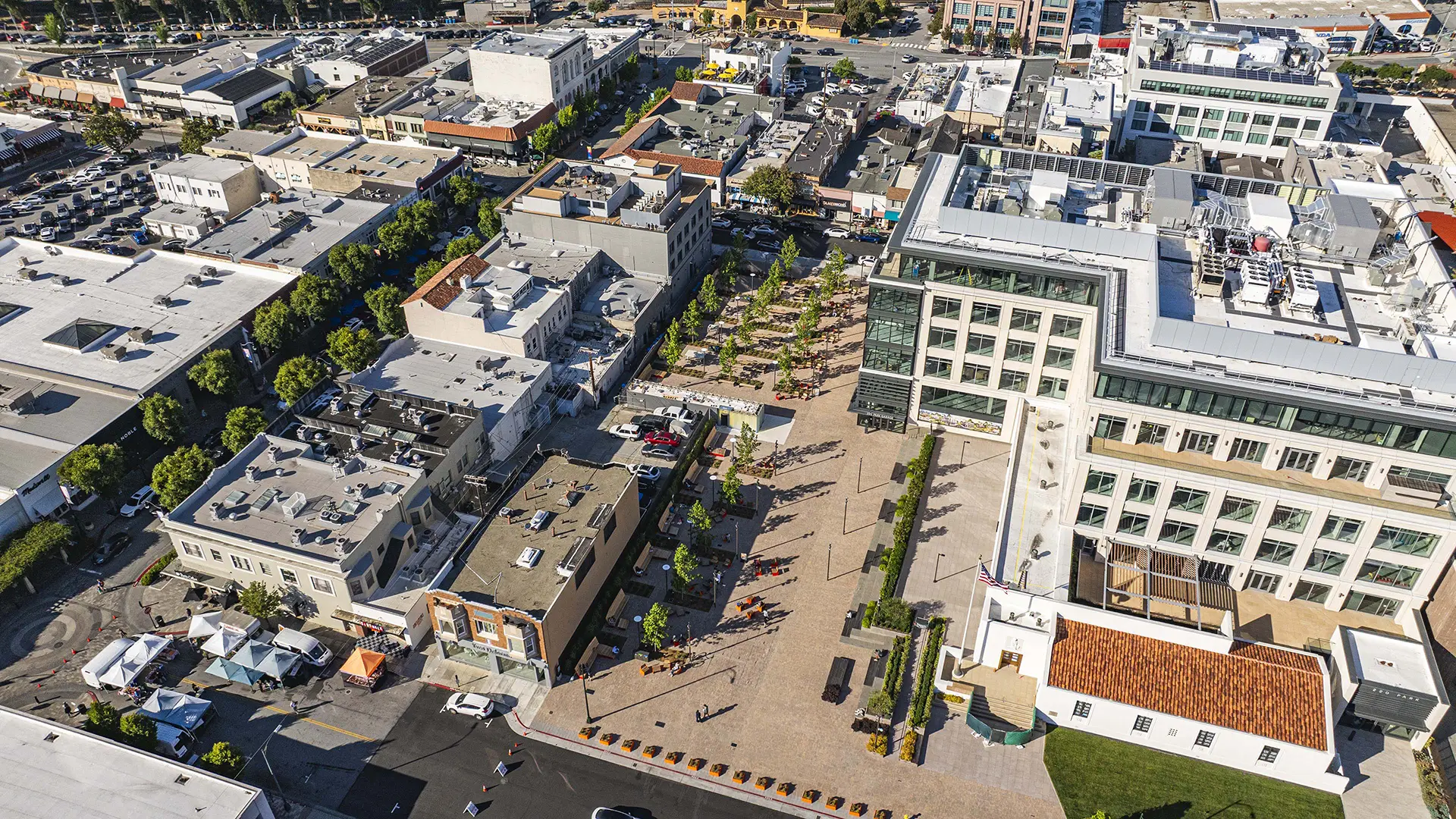


Since its founding in the early 1900s, Burlingame lacked a signature downtown open space. In 2009, the mayor and council kicked off an initiative to make downtown more pedestrian-friendly, including enhancing the Burlingame Avenue retail main street. The capstone of that initiative is the transformation of a one-acre parking lot between Park Road and Lorton Avenue into an outdoor living room—opening in 2026 as Burlingame Town Square.
Organized into two distinct zones, the Town Square is overlaid with a grid of deciduous trees, seating clusters, and large custom wood slat benches along the sunny northwest edge. The Park Road half of the Square includes flexible space and a small performance area to host markets and festivals, while the Lorton Avenue half features communal tables and outdoor games. Flanking curbs are designated for drop-off, supporting the Square as a natural meeting and socializing spot downtown.
Midway through the Square, a water feature clad with angled panels of cast dichroic glass shifts from icy white to aqua, gold, and royal blue depending on sun angle and viewing position, screening a public restroom. Throughout, the design features a warm modern design vocabulary with a palette of oranges, reds, and rusts recalling the brick façades and outdoor dining along Burlingame Avenue. After dark, theater-grade projectors wash the Square’s main walk with a shimmering light artwork evoking Burlingame Creek, now culverted below ground.
Through a partnership between the City and developer of 220 Park, an adjacent six-story office building with ground-level retail and an adaptive reuse of a 1941 Art Deco post office, the Square extends beyond the City’s parcel into this development with additional paving, seating terraces, and an elevated dining area and restaurant. Over time, other surrounding buildings are anticipated to open up to the Square, completing its function as a defining civic gathering space for Burlingame.
Brackenridge Park
At the confluence of the San Antonio River lies Brackenridge Park, a once postcard-worthy destination with a rich heritage obscured by years of neglect.
Reimagining cultural landscapes requires balancing historic preservation, ecological health, and visitor experience. Rather than opting for piecemeal rehabilitation as originally proposed by the city, S...
San Pedro Street Pedestrianization
SWA created a vision for transforming North San Pedro Street in the heart of Downtown San Jose into a vibrant pedestrian outdoor dining and socializing space, formalizing and enhancing what local restaurants and city leaders had begun during COVID-19. The design replaces the existing curbs and roadbed with plaza paving to create a continuous space for people w...
Gantry Plaza State Park
Once a working waterfront teeming with barges, tugboats, and rail cars, the Hunter’s Point shoreline slowly succumbed to the realities of the Post-Industrial Age and this spectacular site was left to deteriorate. Thomas Balsley Associates, together with Weintraub di Domenico, envisioned Gantry Plaza State Park as a place that celebrates its past, future, skyli...
Golden Gate National Recreation Area
In the early 1970s, the National Park Service began the enormous task of creating a new national recreation area in the midst of an urban center—the San Francisco Bay Area, home to 4.5 million people at the time. Riding the wake of the environmental revolution of the late 1960s, the Park Service would need to find consensus among a wide range of constituents, ...