


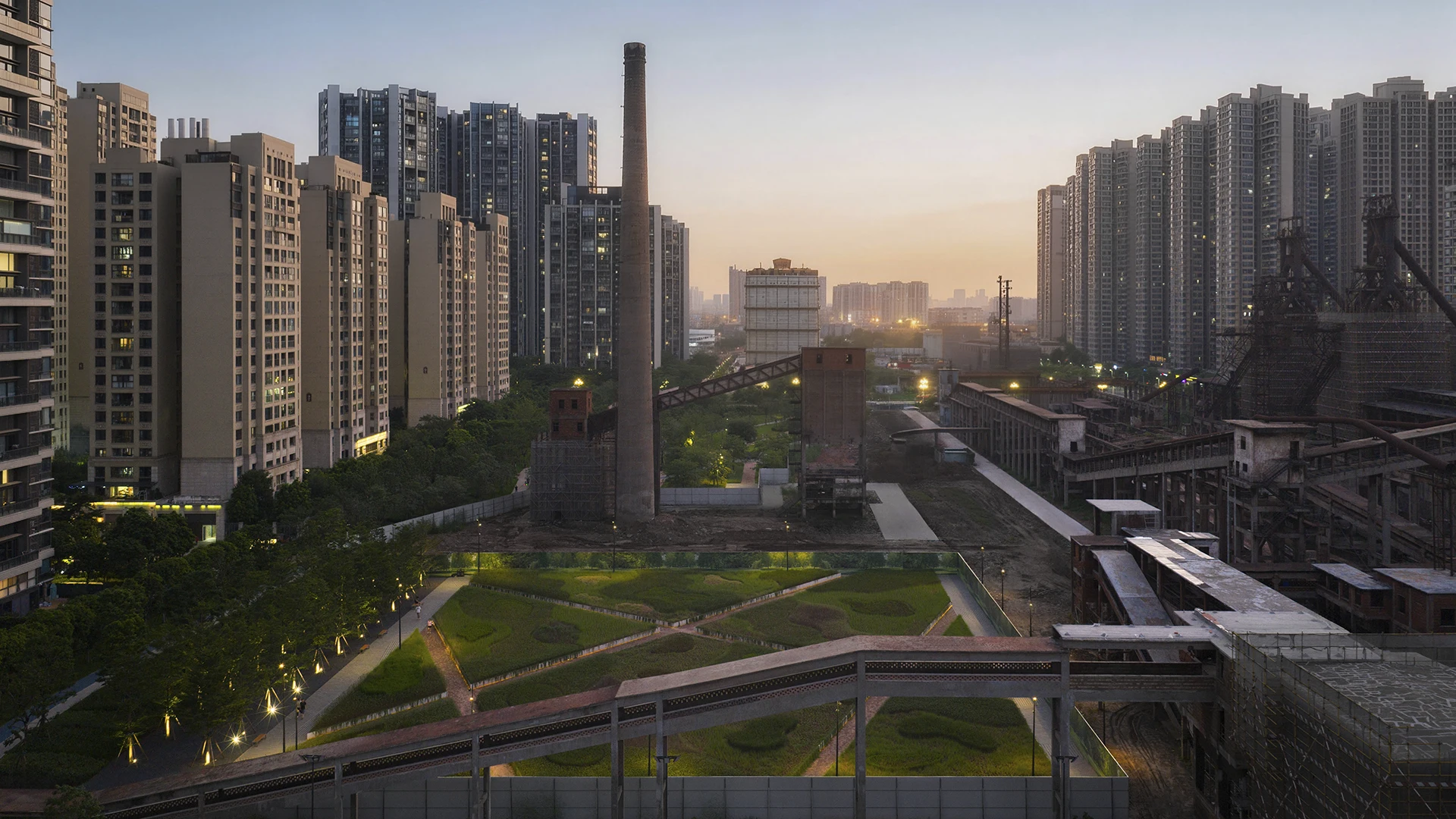


Along the Pearl River, this stretch of Guangzhou’s industrial belt produced steel for nearly seven decades. Following the factory’s decommissioning in 2013, the site has been transformed into a carbon-negative landscape that weaves its industrial past into every design decision. Guangzhou Steel Park reshapes a legacy of environmental degradation into a model of ecological resilience for the surrounding community and the wider city.
Forests, wetlands, and meadow gardens act as carbon sinks, neutralizing the footprint of the former production line, while its relics are reused rather than demolished. Former conveyor belts become pollinator gardens; ore mounds shaped by decades of machinery use are reworked into amphitheaters and observation platforms; preserved railways are reinterpreted as narrative landscapes that honor the site’s history; and blast furnace zones rise as elevated sky gardens, where vegetation sequesters CO2 and mitigates the urban heat island effect.
Sustainability strategies extend throughout the park. Stormwater gardens filter runoff, reduce irrigation needs, and double as recreational space. Low-carbon materials—permeable paving from recycled slag and brick, locally sourced stone, and monolithic wood seating—further limit embodied emissions. A repurposed chimney symbolizes the park’s carbon-negative ambitions, supported by solar power and energy-efficient lighting.
Guangzhou Steel Park shows how landscapes can absorb carbon, increase biodiversity, and restore social life to industrial land—both a living record of the city’s industrial heritage and a model for post-industrial sites.
Bend of the River Botanic Garden
The Bend of the River Botanic Garden Master Plan reimagines an 88-acre site in Temple, Texas, into a regional attraction. Situated at the intersection of I-35 and the Leon River, the site comprises two donated parcels, consolidated to serve Temple’s growing population of over 96,000.
SWA led a comprehensive public engagement process, facilitating conver...
Peanut Plaza
Reclaiming private land for public use, one of Washington D.C.’s most dangerous intersections has been targeted for vast improvements. The project kicked off with the demolition of a Wendy’s restaurant on site and implemented new road alignments to ease traffic congestion. SWA worked with NoMa community groups and the Department of Transportation on the new vi...
Evelyn’s Park
In honor of their late matriarch Evelyn, the Rubenstein family donated a historically and geographically prominent five-acre tract on the busy Bellaire Boulevard and created a conservancy to fund a public park with primarily private funds, while engaging the public in its design and development. This park seeks to be reflective and adaptive to the local cultur...
Homecrest Playground
Part of the larger Shore Parkway, an 816.1-acre collection of parks that stretches across Brooklyn and Queens, Homecrest Playground originally opened in 1942 with a baseball field, basketball courts, handball courts, and benches for community use. This park redesign focuses on providing different playground and recreation amenities for surrounding residents.