


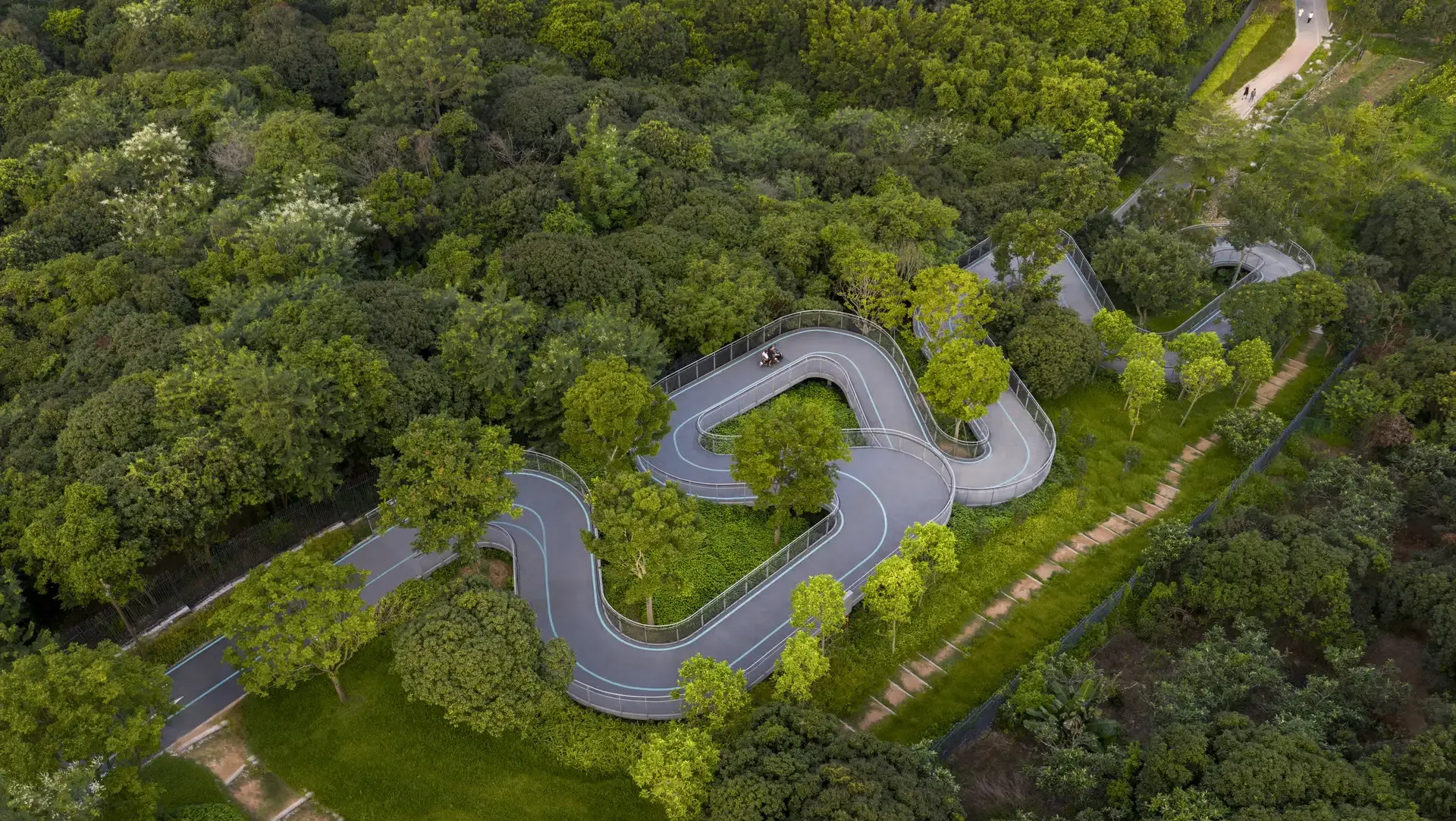


Encircling one of Shenzhen’s four major reservoirs, Xili Lake Greenway is the third segment of the 200-kilometer Kunpeng Trail to be completed under the city’s Mountain-Sea-City corridor initiative. Navigating over 16 kilometers of diverse terrain across upland, densely forested, and urban landscapes, the trail connects Xili Science and Education City, 18 technical universities and research institutes, to the rural villages of Dakan, Makan, and Baimang—communities renowned for lychee farming—transforming a restricted utility zone into a verdant ecological corridor brimming with public life.
Across highly constrained conditions, SWA’s design incorporates low-impact development principles, using regionally-sourced granite and repurposed eucalyptus and lychee wood as core materials, as well as gabion cages filled with stone and pruned branches to slow slope erosion and capture sediment runoff. This approach extends to water management, where channelized reaches of the Lishui and Dakan Rivers have been renaturalized to allow seasonal flooding and public access, punctuated by overlooks, get-downs, and stepstone crossings.
In urban sections of the trail, sidewalks and fences were reconfigured and expanded to carve out room for multimodal trails and, to the south, a linear water pavilion floating along the lake’s edge. In forested segments, SWA coordinated with rural farmers in developing an ecotourism plan centered around lychee products to boost the local economy without overly straining rural infrastructure. In hilly areas, elevated boardwalks lift above grade, weaving carefully around the existing canopy. Altogether, the broader greenway—a feat of cross-jurisdictional mediation, ecological restoration, and cultural revitalization—redefines the reservoir as a shared civic landscape, linking an emerging university hub to the agrarian traditions of Shenzhen Nanshan’s northern villages.
Mason Park Bridge
Mason Park, located at the confluence of two bayous, has served as an urban oasis since 1928. Despite a century of improvements to amenities, user access was significantly compromised by the wide expanse of Brays Bayou, which bisected the 104-acre green space into distinct northern and southern sections. Adjacent road and rail infrastructure further exacerbate...
Jeffrey Open Space Park
The Jeffrey Open Space Park represents approximately 96 acres of park and trails, with an average width of 265 ft. The three-mile long spine is designed for passive uses with a network of trails that connect to residential neighborhoods and active recreation parks.
The design process included a series of community workshops to solicit community’s commen...
Sanshan Hillside Park
The Pearl River Delta has undergone a dramatic transformation over the past four decades, evolving from farmland to a global manufacturing and technology powerhouse. Amid the frenetic pulse of this sprawling megalopolis of 86 million people, Sanshan Hillside Park stands as a mountaintop oasis.
Envisioned as New Town’s Central Park, the design embr...
Hi Line Connector
The Hi Line Connector spans one mile through Dallas’ Design District, linking two of the city’s most valuable urban core public assets: the Katy and Trinity Strand Trails. This transformative project introduces raised bike lanes and enhances the pedestrian experience by improving and realigning existing roadways. Beyond the physical infrastructure,...