

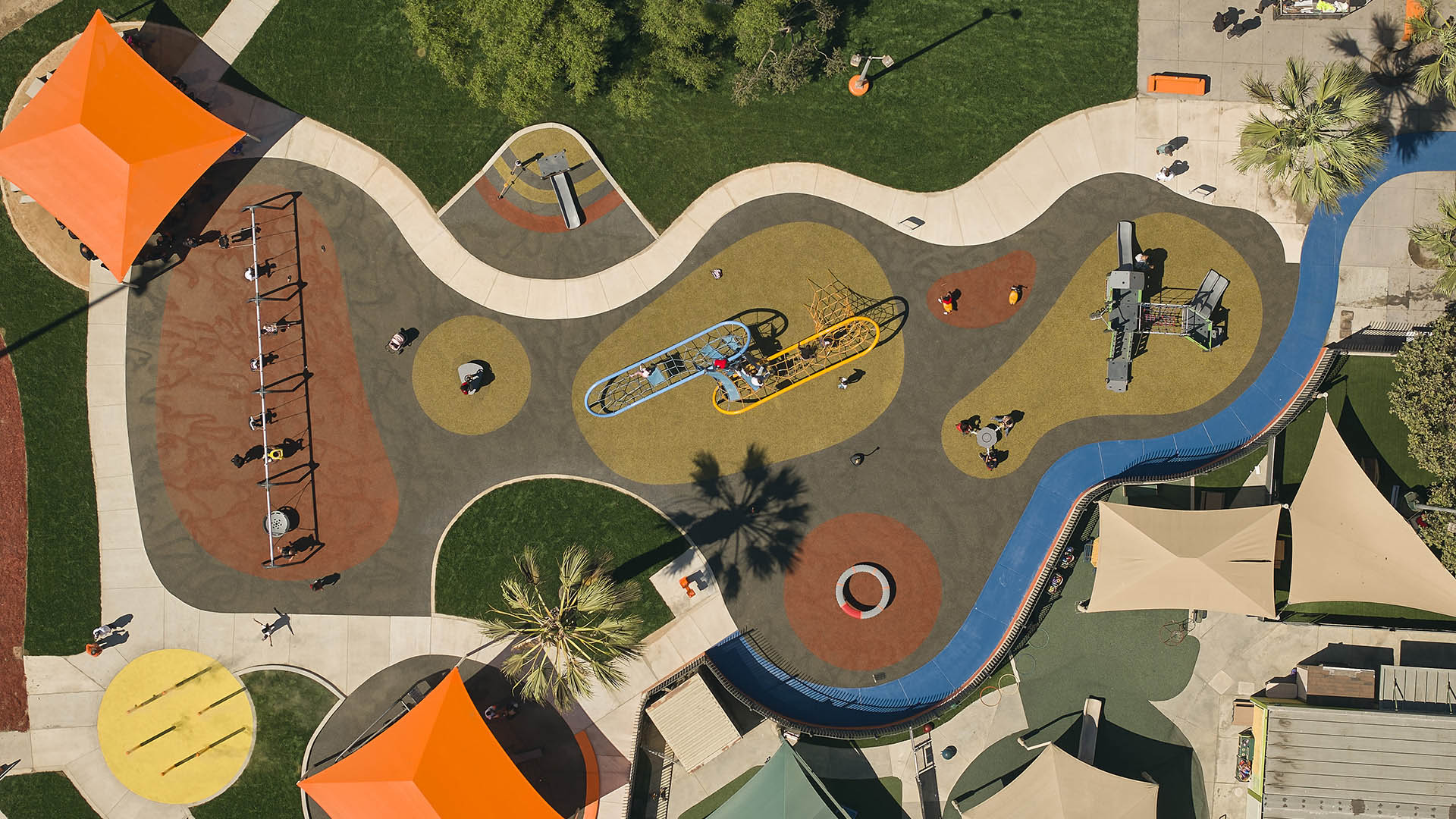
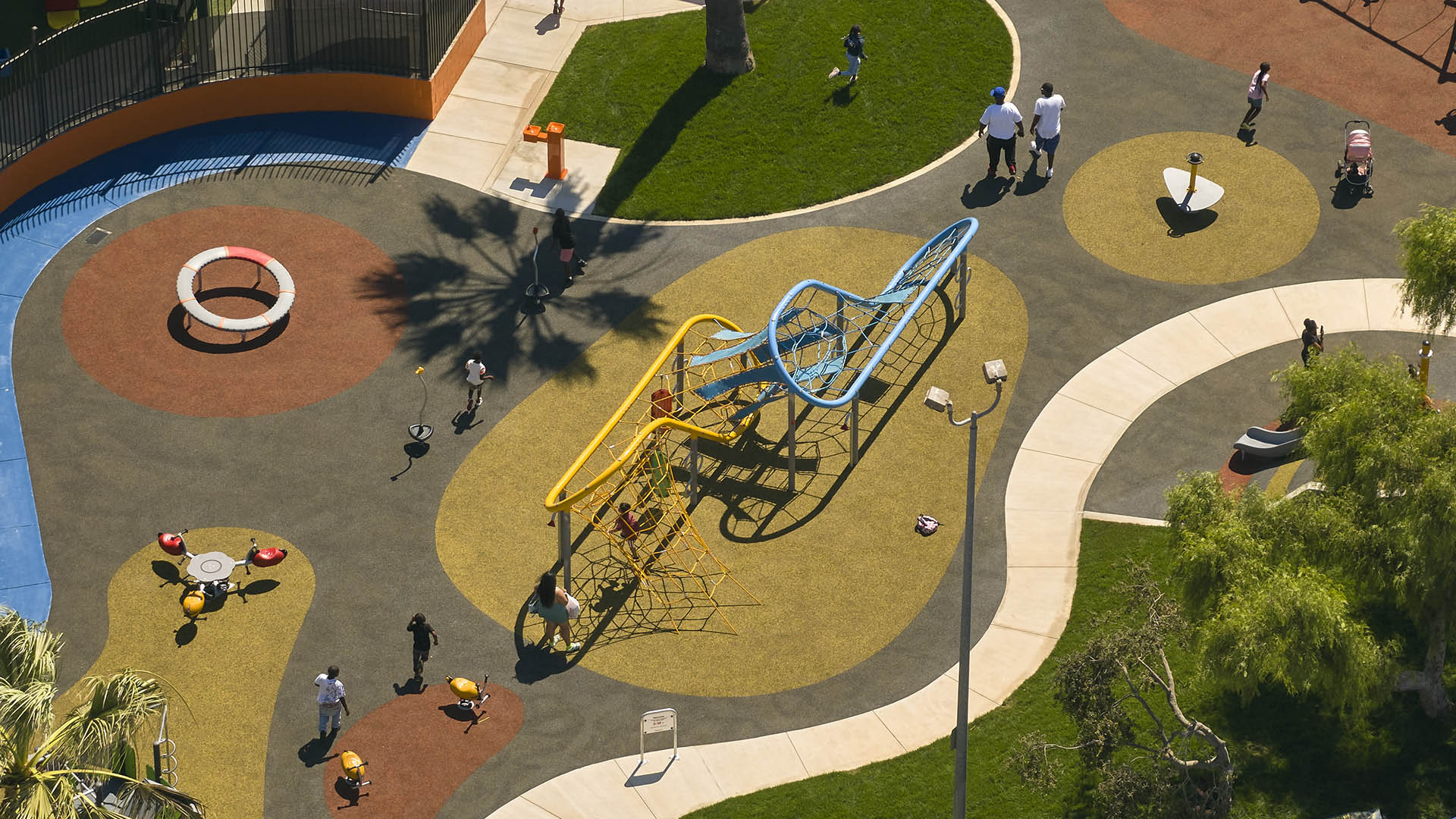
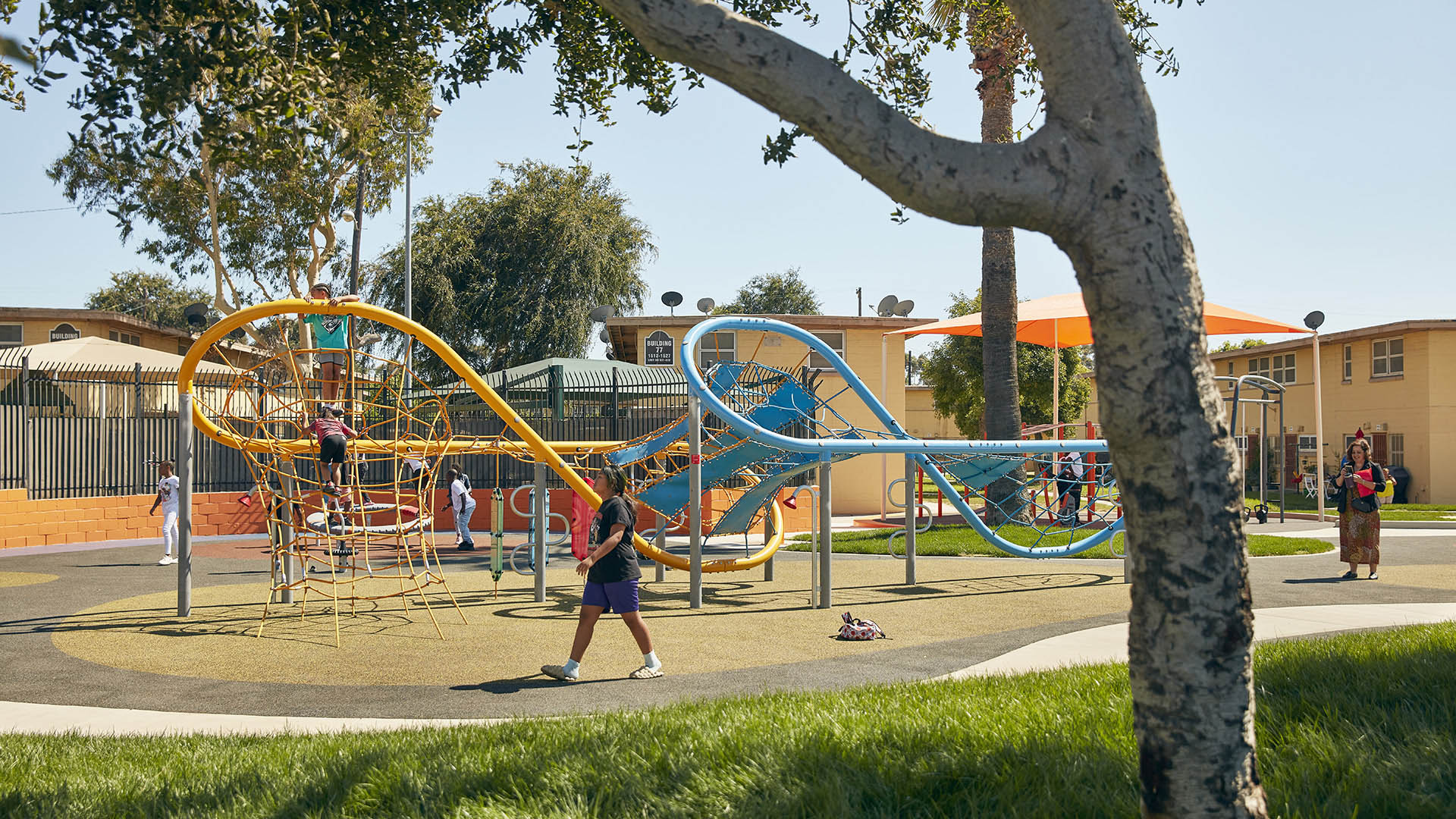


Originally designed in 1955 by architect Paul Revere Williams, Nickerson Gardens is a 1,066-unit apartment complex in Watts, South Los Angeles — the largest social housing project west of the Mississippi. Core to Williams’ vision was an emphasis on shared open space, but its central playground, neglected for years, fell into a state of disrepair. In collaboration with NBBJ and the musician Flea, SWA’s Los Angeles studio provided pro-bono advisory services to design the landscape for an entirely refurbished playground — including slides, swings, misting features, shade structures, and an adult exercise facility. Complete with water-efficient plantings, the playground brings 17,656 square feet of vibrant new community space to the heart of Nickerson Gardens, designed with durability, heat resistance, and multi-generational use in mind.
Hill at Sims
Set along Sims Bayou in Sunnyside, one of Houston’s oldest historically Black communities, Hill at Sims transforms a 106-acre stormwater detention basin into a regional park that pairs flood protection with public access, ecological restoration, and everyday recreation. Built around a four-story mound of earth created during the basin’s excavation in 2005, the...
Ricardo Lara Park
Ricardo Lara Park is a vibrant city park and a case study in landscape infrastructure. It demonstrates how a small investment and creative thinking about landscape can transform the very infrastructure that has long divided and isolated a community into an amenity that unites it, offering much-needed environmental and recreational benefits.
Here, more ...
Honggang Park
Nestled between two hills in Shenzhen’s Luohu District, Honggang Park is a green corridor bringing over 80 acres of open space through the city’s dense fabric. Celebrating the site’s stark topography, SWA’s design carefully threads hiking trails along the slopes to minimize ecological disturbance, with stairs providing shortcuts along switchbacks. Altogether, ...
Evelyn’s Park
In honor of their late matriarch Evelyn, the Rubenstein family donated a historically and geographically prominent five-acre tract on the busy Bellaire Boulevard and created a conservancy to fund a public park with primarily private funds, while engaging the public in its design and development. This park seeks to be reflective and adaptive to the local cultur...