


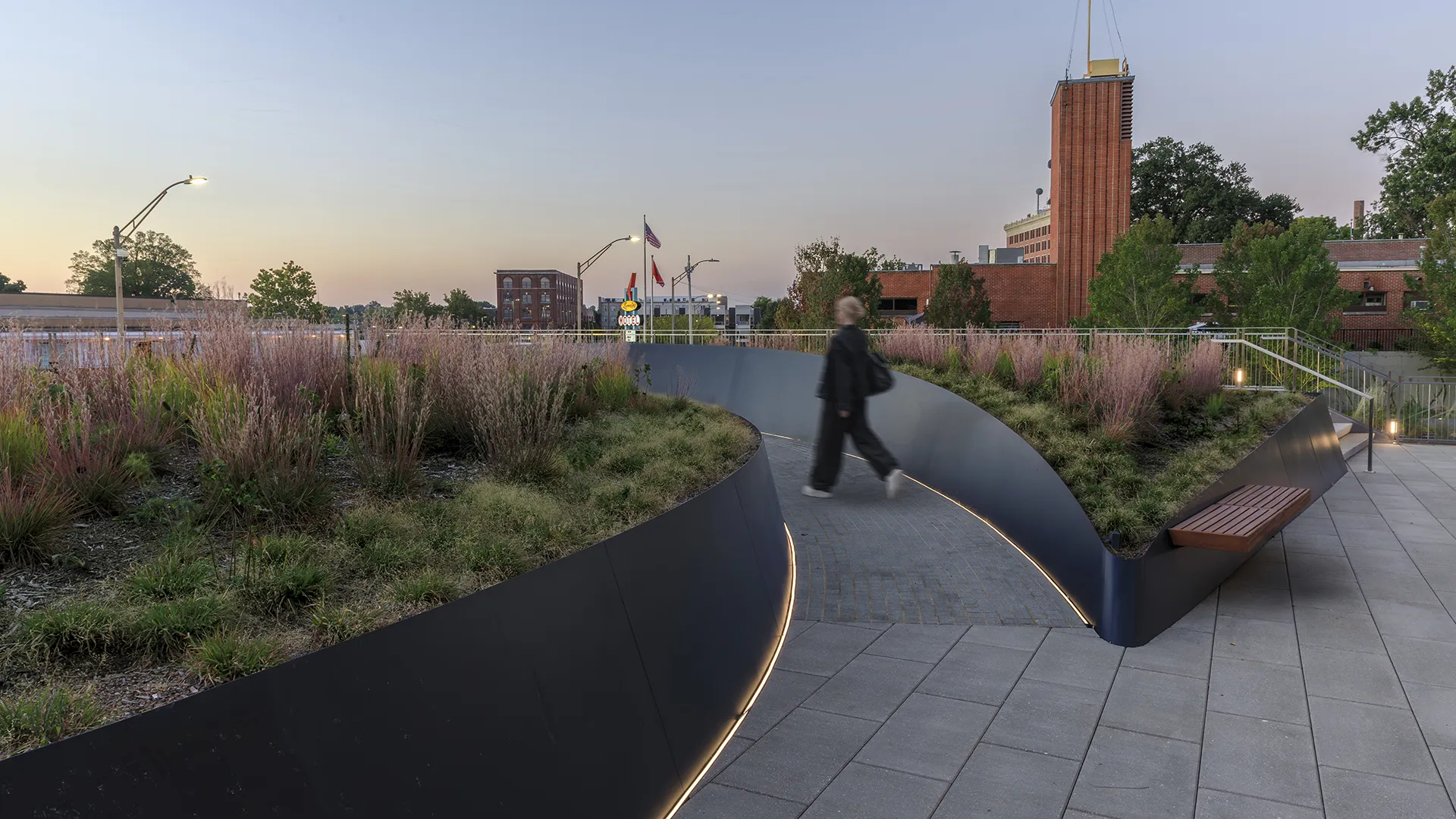


Located at the Lorraine Motel—site of Dr. Martin Luther King Jr.’s assassination on April 4, 1968—the National Civil Rights Museum serves as both a national institution and an international destination for reflection and remembrance. Led by Howard+Revis in collaboration with Self+Tucker and SWA, the west campus landscape design represents a return to a site of profound historic and cultural significance where the same team shaped the Museum’s first major expansion two decades prior.
The new phase of work expands the Museum campus with three key landscape interventions. Founders Park includes an amphitheater for performances and civic gatherings, with visual axes carefully aligned toward the Lorraine Motel balcony where Dr. King stood. Shaded “ascending rooms” provide intentional spaces for outdoor educational sessions. The Legacy Terrace, a panoramic overlook offering new vantage points of the motel balcony, features native meadow-inspired planting paired with contemplative gathering spaces organized into a flowing, curvilinear form.
The design team collaborated closely with the Museum and its steering committee to ensure that the landscape provides a powerful yet understated backdrop to the historic motel while preserving the authenticity of the site, a key step as the Museum pursues UNESCO World Heritage designation.
New entries, signage, and lighting improve connectivity and visitor experience, carefully minimizing visual clutter so that the Lorraine Motel remains the site’s defining landmark. Subtle design gestures, such as stainless steel lines embedded in paving forming a viewshed toward the balcony where Dr. King stood, acknowledge history without prescribing an interpretation of events. Seasonal planting, designed in collaboration with award-winning horticulturist Patrick Cullina, recalls the historic field conditions around the motel while providing color and bloom cycles timed to annual commemorations like MLK Day.
The Museum’s new Legacy Building and renovated Boarding House are scheduled to open in April 2026, completing this significant expansion of one of America’s most important civil rights landmarks.
The Iris and B. Gerald Cantor Center for the Visual Arts
The original Stanford campus museum was damaged in an earthquake in 1989. With help from major namesake donors to the museum, significant site improvements, expansion and seismic renovation improvements were accomplished. SWA provided master plan updates and full landscape architectural services including pedestrian pathways; two major terraces for displaying ...
Dallas Museum of Art Competition
Within the winning team led by Nieto Sobejano Arquitectos, SWA’s landscape solutions for the Dallas Museum of Art (DMA) are fundamental to addressing the institution’s renovation goals. The transformation includes vibrant gathering spaces that communicate the Museum’s core values of community and environmental responsibility. These additions ...
Library of Congress Packard Campus
A 45-acre site 70 miles southwest of Washington, D.C. serves as the home for the Library of Congress’s Motion Picture, Broadcasting, and Recorded Sound Collections. The 400,000-square-foot complex consolidates the world’s largest audio-visual collection and provides improved facilities for research, digital conversion, long-term conservation, and public apprec...
Fort Worth Museum of Modern Art
SWA was selected to provide design services for the new Modem Art Museum of Fort Worth located across the street from the renowned Kimbell Art Museum designed by architect Louis Kahn. The direction for the landscape concept here evolved from the vision of Japanese architect Tadao Ando, whose design was selected as the winning entry in an international invitati...