


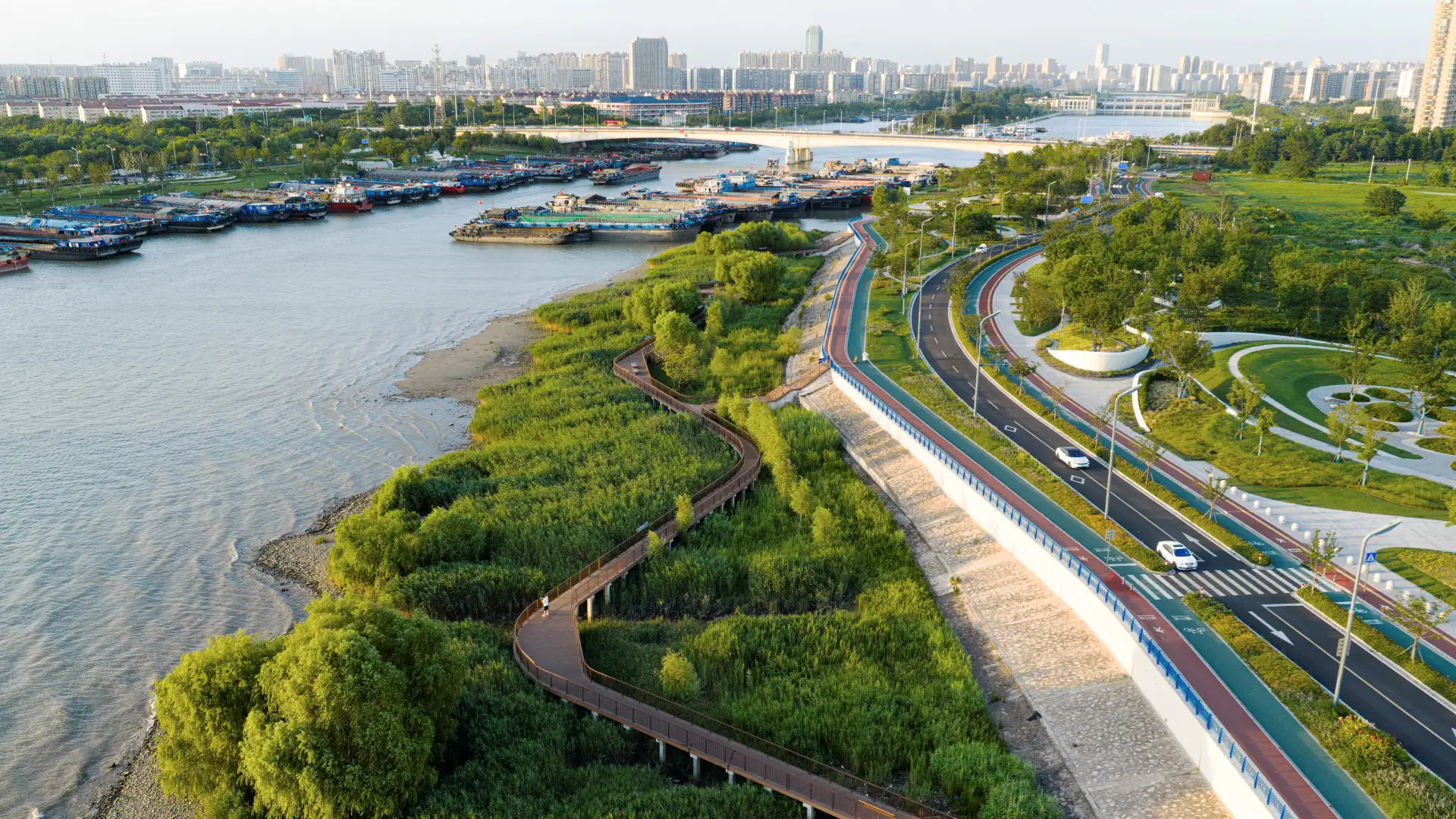


A prominent riverfront city in Jiangsu Province, Nantong has long been shaped by its proximity to the Yangtze River, Hao River, Tonglv Canal, and Rengang River. The establishment of Nantong Port in 1904 and subsequent wharf construction drove decades of industrial growth, but as shipping operations shifted downstream to deeper waters, older docks in this area were gradually decommissioned. In 2019, the city launched an ambitious plan to transform nearly 20 kilometers of industrial docks into green public space, with the first five-kilometer phase centered on the Tonglv Canal, Rengang River, and Riverside Flower Meadow—an area totaling one million square meters.
The project reconnects communities with the waterfront while integrating new flood-control infrastructure. The design introduced program zones, activity spaces, and commercial activation strategies to revitalize the waterfront. A sequence of promenades, plazas, and waterfront terraces creates a layered public experience, reconnecting residents to the river’s edge.
Ecological protection was a central priority. In collaboration with hydraulic engineers, the team preserved sedimentary riverbanks at key confluences, supporting diverse migratory bird habitats. Low-impact boardwalks weave through reed beds, allowing visitors to experience the river ecology without disturbing it. In total, 28,000 square meters of wetlands were safeguarded.
SWA served as lead landscape designer, responsible for the overall design vision and schematic development. Shanghai Municipal Engineering Design Institute acted as the project’s general design institute, overseeing multidisciplinary engineering, infrastructure systems, and detailed implementation. The first three phases have been open to the public since 2024.
By integrating public space, industry, and ecology, the project restores Nantong’s historic river culture while establishing a forward-looking model for resilient, multifunctional waterfront redevelopment along the Yangtze River.
Embankment Square
The Embankment Square is located along the east bank of the Huangpu River in Shanghai. The project consists of landscape areas in three office parcels and one waterfront park parcel. The view of the site is remarkable, looking toward the landmark skyscrapers of Lujiazui Financial Center, Nanpu Bridge, the Bund, and the Minsheng CBD.
The design concept c...
Changsha Baxizhou Island
Over many decades, public agencies in China have sought to solve growing flooding issues in a defensive way: fortifying and hardening river edges, raising levee heights, and ultimately separating the people from historical connections to the water. With an understanding of river flow processes and volumes and of wetland and native forest ecology, this separati...
Shekou Promenade
A gateway for China’s open-door policy, Shekou has revitalized its fragmented and hazardous coastline into a dynamic six-kilometer promenade that masterfully captures the area’s cultural and natural essence.
The promenade repurposes the disconnected former industrial waterfront into a celebrated open space system with new recreation programs...
Longgang River Blueway System
The Shenzhen Longgang River Blueway System is envisioned to unlock the tremendous land value of this 13-mile-long suburban watershed and galvanize the city’s future growth. SWA’s proposal addresses urbanization issues pertaining to water, the environment, and open space shortage, while also activating industrial and cultural revitalization in the surrounding d...