


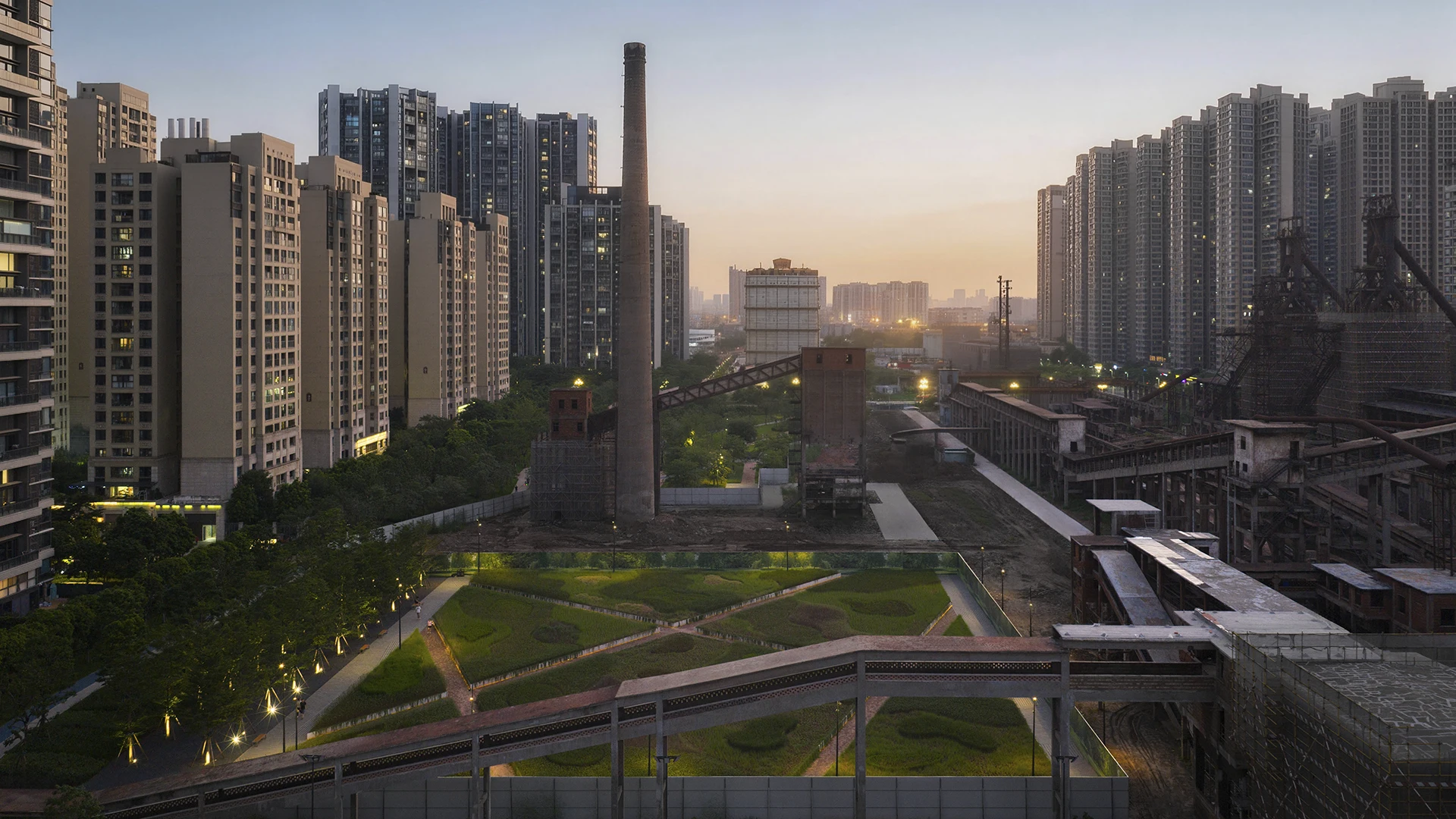


Along the Pearl River, this stretch of Guangzhou’s industrial belt produced steel for nearly seven decades. Following the factory’s decommissioning in 2013, the site has been transformed into a carbon-negative landscape that weaves its industrial past into every design decision. Guangzhou Steel Park reshapes a legacy of environmental degradation into a model of ecological resilience for the surrounding community and the wider city.
Forests, wetlands, and meadow gardens act as carbon sinks, neutralizing the footprint of the former production line, while its relics are reused rather than demolished. Former conveyor belts become pollinator gardens; ore mounds shaped by decades of machinery use are reworked into amphitheaters and observation platforms; preserved railways are reinterpreted as narrative landscapes that honor the site’s history; and blast furnace zones rise as elevated sky gardens, where vegetation sequesters CO2 and mitigates the urban heat island effect.
Sustainability strategies extend throughout the park. Stormwater gardens filter runoff, reduce irrigation needs, and double as recreational space. Low-carbon materials—permeable paving from recycled slag and brick, locally sourced stone, and monolithic wood seating—further limit embodied emissions. A repurposed chimney symbolizes the park’s carbon-negative ambitions, supported by solar power and energy-efficient lighting.
Guangzhou Steel Park shows how landscapes can absorb carbon, increase biodiversity, and restore social life to industrial land—both a living record of the city’s industrial heritage and a model for post-industrial sites.
San Pedro Street Pedestrianization
SWA created a vision for transforming North San Pedro Street in the heart of Downtown San Jose into a vibrant pedestrian outdoor dining and socializing space, formalizing and enhancing what local restaurants and city leaders had begun during COVID-19. The design replaces the existing curbs and roadbed with plaza paving to create a continuous space for people w...
San Antonio Spirit Reach
San Antonio’s river trail system has long stood incomplete, its northern reach at Brackenridge Park abruptly halted by a patchwork of private lands. Recognizing the waterway’s cultural significance, landowners forged an unprecedented partnership, opening sections of their properties for public benefit. The 162-acre Spirit Reach Vision Plan allows v...
Ontario Grand Park
Dating back to the late 1800s, Ontario, California, has been an ideal destination for agriculture, boasting orange, peach, lemon, and walnut groves. With an economy now based in manufacturing, access to an international airport, and proximity to Los Angeles, Ontario’s population is predicted to double by 2035. In response to the growing community, Ontario Gran...
Elk Grove Civic Center
SWA’s design for this community resource improves upon part of a 56-acre master plan with a civic center campus set within a beautiful park, and an added public outdoor commons. The pedestrian-friendly commons weaves new buildings together with mature trees and an outdoor living space linking together a community center, an aquatics center, and a future librar...