


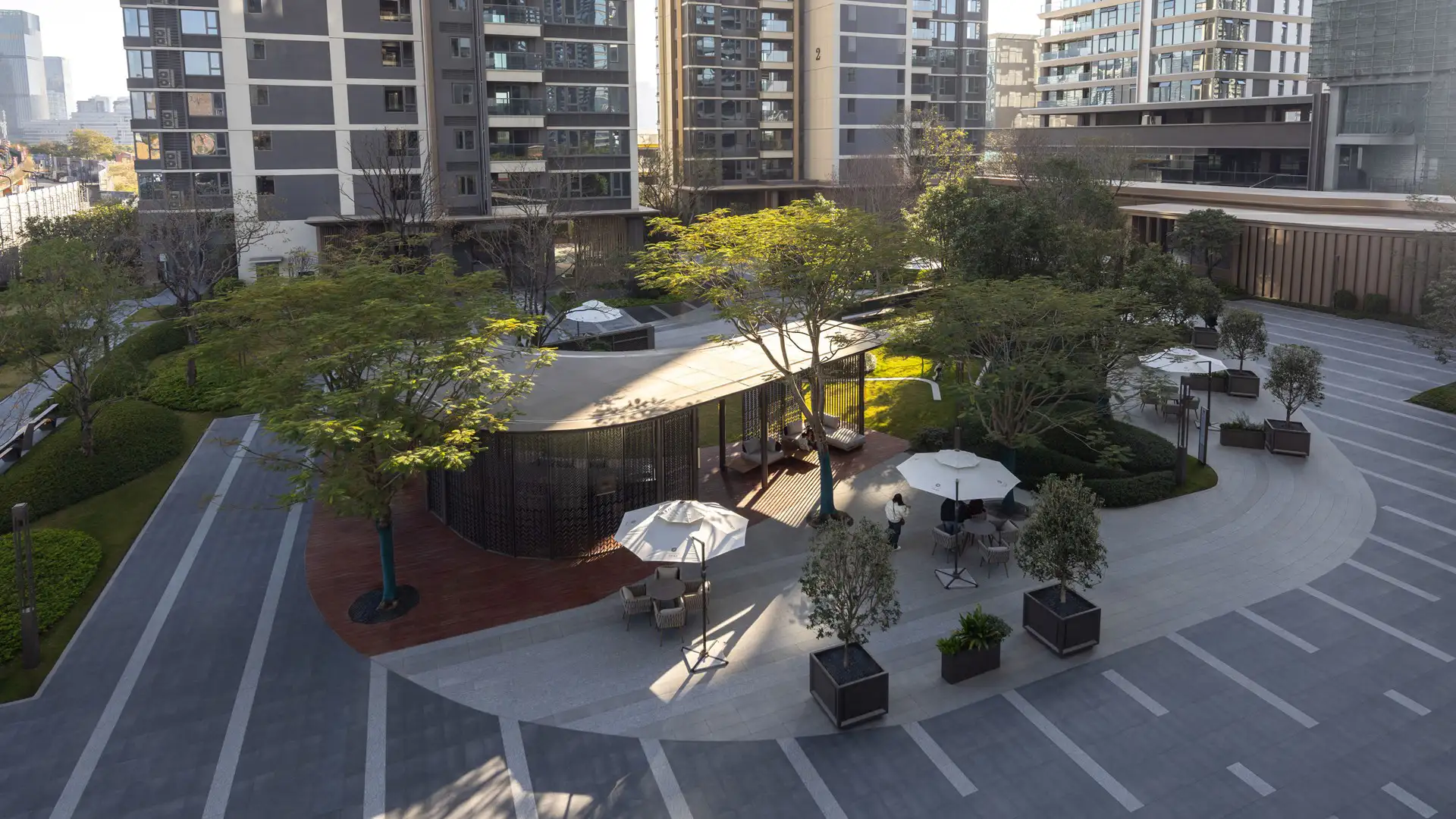


Situated within Foshan’s emerging art district near the Nanhai Art Center, Poly VITA reimagines high-density residential living by drawing from the spatial traditions of Lingnan water town culture. The design translates the layered, processional quality of classical southern Chinese gardens into a contemporary community landscape, moving residents through a sequence of art-infused spaces from the public edge to the intimate residential core.
A looping trail system doubles as required fire access while connecting exercise stations, contemplative gardens, and children’s play areas throughout the site. Rather than treating safety infrastructure as a constraint, the design integrates it into a continuous recreational path that threads together the community’s activity nodes.
At the heart of the development, a sculptural pavilion inspired by Lingnan tea house architecture anchors a gently bermed amphitheater, offering flexible space for daily use and larger community gatherings. Surrounding gardens draw on regional cultural programs, incorporating native species — Albizia falcataria, Terminalia mantaly, and Sweet Osmanthus — to reinforce a sense of place while mitigating urban heat island effects.
Custom paving patterns reference the Poly brand identity, marking arrival moments at building entries, while a layered lighting program featuring sculptural installations extends the landscape’s utility into the evening hours.
SunCity Tachikawa Showa Kinen Koen
SunCity Showa Kinen Koen takes its name from the beloved Koen National Park that borders the development to the east and south. Built to commemorate the 50th anniversary of Emperor Showa’s reign, the park offers an ideal setting for Half Century More’s flagship continuum-of-care retirement community, with 518 independent living units and 82 nursing...
Harvest Green
Harvest Green is unique among master-planned communities in the Houston area. Resident lifestyles at Harvest Green are activated through community farming, wellness programming and generous amounts of community green space. A community recreation center, village farm, parks, and entry monumentation will be completed during the first phase of construction. Coll...
SunCity Tower Kobe
Kobe has a unique geographical context in Japan, with breathtaking views both inland to Mt. Rokko and to the broad expanse of Osaka Bay to the south. The landscape design of SunCity Tower Kobe, a landmark senior community in this newly developed city district, celebrates this environment. The tower is tucked into the northwest corner of the site, setting it aw...
The Summit
Offering iconic views of the East River and Chrysler Building, residents can find serenity without sacrificing convenience in East Midtown’s The Summit. The tower’s “public face” is set back from the street, where a circular motor court establishes an elevated and elegant tone as residents arrive at the project. The ground level includes a reflecti...