


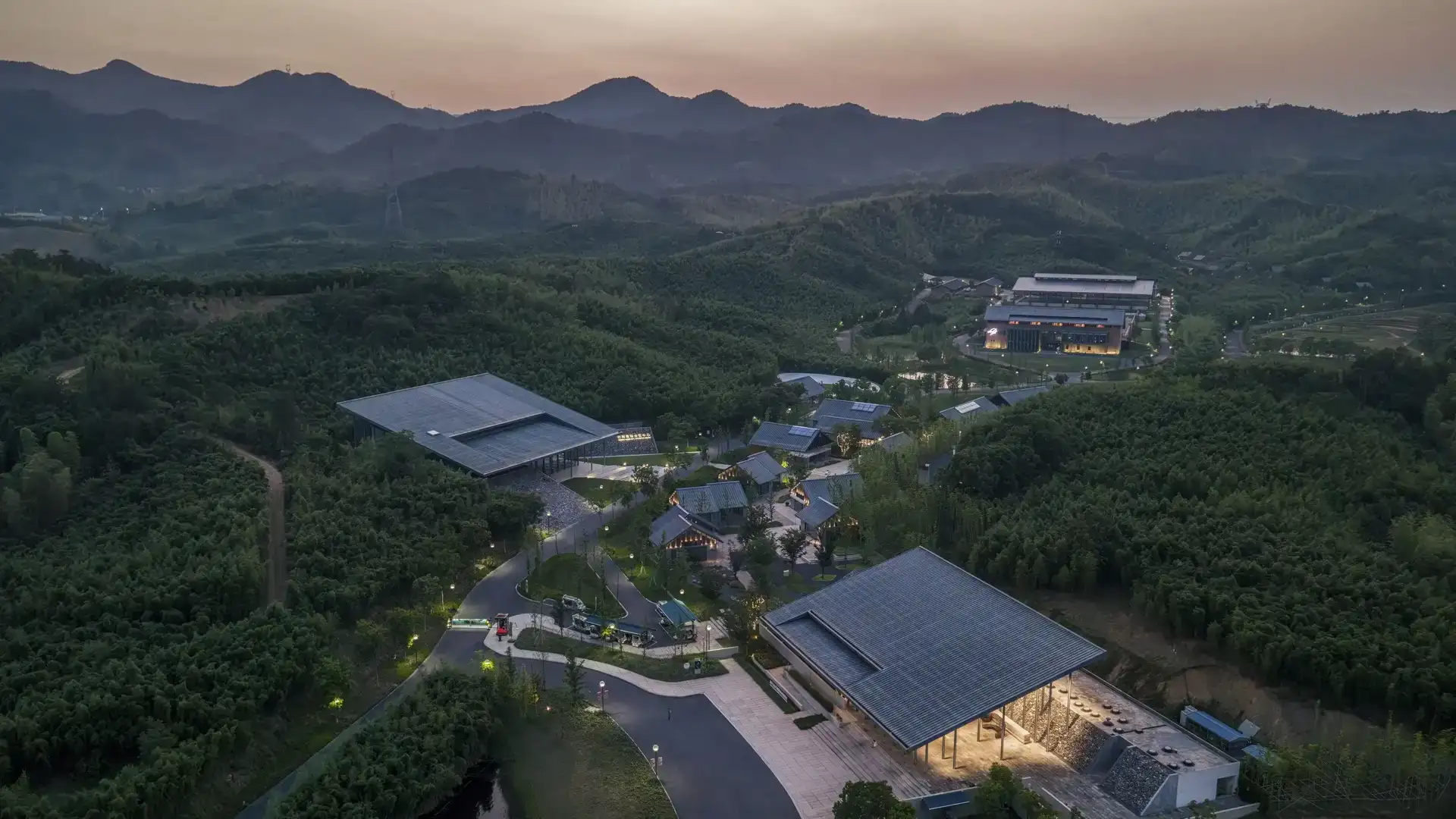

Set within the quiet valley neighboring Moganshan (Mount Mogan), the 247-acre Elephant and Moon Resort unfolds as both a retreat and conference center—an immersive landscape shaped by the client’s ethos, “A passion for the outdoors.” At the heart of the site, a traditional mulberry dyke fishpond anchors the master plan, embodying a cyclical agricultural system in which waste becomes resource. By elevating a minimized reservoir into an essential piece of hydrological infrastructure, the design establishes water as the fundamental spatial organizer. A resilient Sponge City strategy responds to monsoonal pressures and complex topography, absorbing, filtering, and reusing stormwater while shaping paths, clearings, and gathering spaces. The planting strategy prioritizes indigenous Yangtze River Delta species arranged to form robust, self-regulating plant communities. Chemical inputs are replaced with Integrated Pest Management and habitat diversification, fostering biodiversity and long-term resilience.
Rather than imposing material-intensive amenities, the design leverages the valley’s natural assets to minimize carbon footprint and maximize experience. Lodging cabins, campgrounds, and tea houses function as spatial punctuation along ecological corridors. Reclaimed stone, timber, and recycled aggregates reduce embodied carbon, while vernacular craftsmanship and local artisans ground the project in regional tectonic heritage. Organic cultivation, bamboo harvesting, and chestnut foraging are core to the project’s programming. By ensuring local farmers continue to reside and work on-site, the landscape integrates community engagement directly into its programming.
Within the broader agrarian narrative, the “Play, Fish” sculpture emerges as a focal point in the children’s playground. Inspired by a leaping fish rising from a traditional sangji pond, the installation references circular agriculture while translating it into childhood discovery. A white terrazzo surface ripples outward like water shaped by terrain, guiding movement and storytelling. Merging ecological symbolism with artistic expression, the piece reconnects play with place—honoring local memory while inviting the next generation to engage with the living systems that define Elephant and Moon Resort.
Larchmont Yacht Club
Larchmont Yacht Club is the second-oldest yacht club in the United States. Conceived in 1880 on the cleft rocks of Larchmont Manor, the club has grown to a membership in excess of 600, with a continued mission to instill and enhance an interest in yachting and the spirit of sportsmanship in members and their families. Set within a mature forest of deciduous tr...
The Resort at Pedregal
Situated at the southernmost tip of Mexico’s Baja Peninsula, Cabo San Lucas is a beautiful illustration of nature at its most diverse. Baja’s dramatic desert terrain is punctuated by the rugged Pedregal Mountain before converging with the pristine sandy beaches along the Sea of Cortez. Crashing blue waves of the Pacific meet the calmer waters of the Sea and cr...
Hanwha Yangpyeong Resort
SWA won a master plan competition for this 900-hectare resort focused on the beauty of the forest and mountains, preserving and enhancing creeks, expanding trails, and experiencing nature. Five villages are proposed within five separate valleys, connected by a common trail system, ponds, and gondola. Existing hot springs will anchor a five-star, Korean-themed ...
Tuckers Point Club Hotel & Spa
The subtropical environment of Harrington Sound, Bermuda, is the home of Tucker’s Point Club Hotel, beach club, villas, and golf community. Originally the site of the ‘30s–era Castle Harbour Hotel, SWA worked to protect much of the indigenous landscape, and site new hotel features on previously developed areas. Amidst the rolling terrain, the 180-room hotel is...