


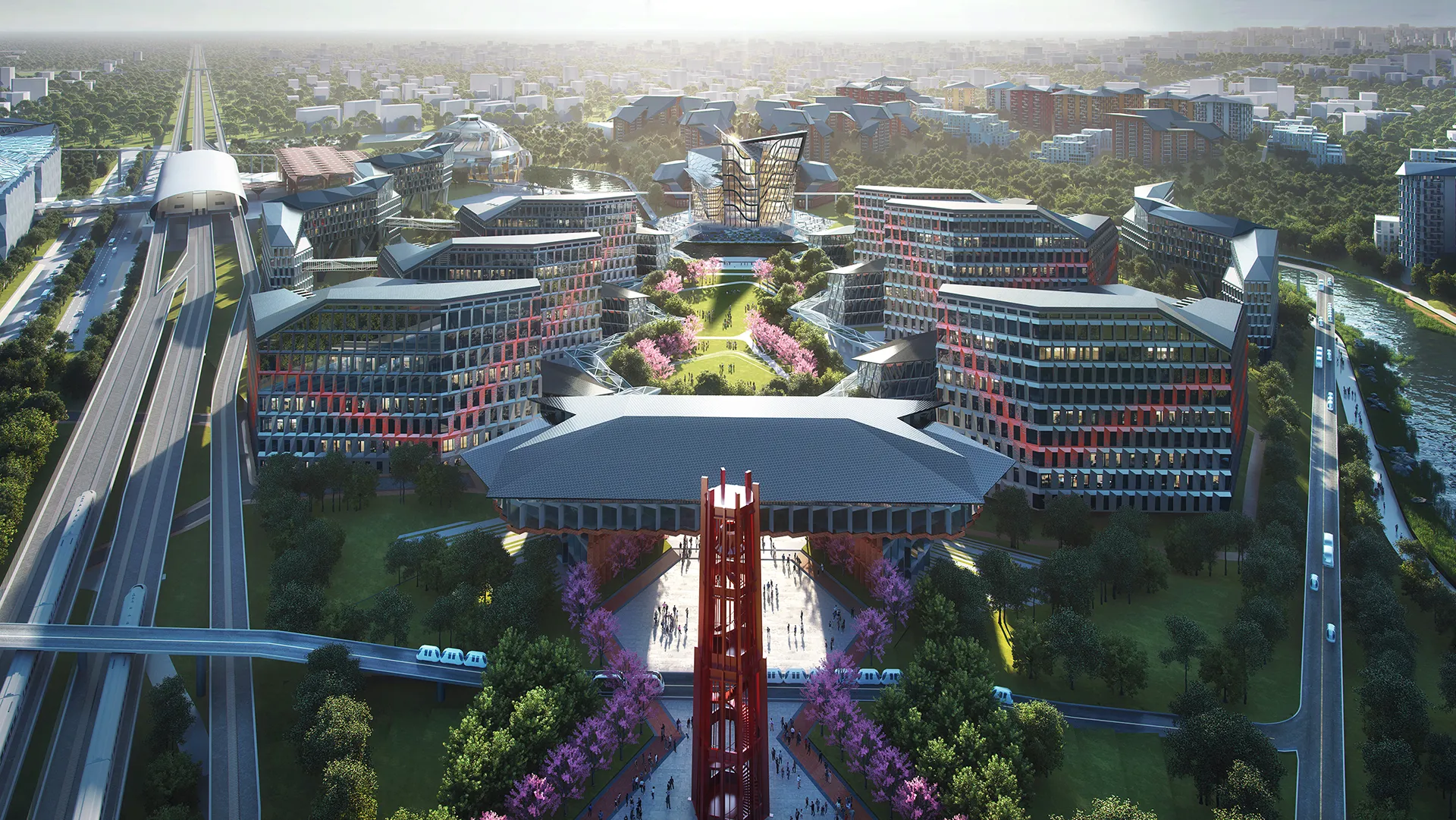


A key inland alternative to China’s coastal tech centers, Chengdu has emerged as a major science, technology, and manufacturing hub. As part of an international design competition for the city’s Hi-Tech Industrial Development Zone organized by a local investment group and the planning bureau, the Chengdu Future Science and Technology City is an achievable visionary model for a next-generation science city, blending business, residential, and academic ecosystems within a highly connected, landscape-driven framework. Spanning approximately 4.6 square kilometers, the district is a center for aerospace, high-end manufacturing, telecommunications, and advanced research, anchored by Chengdu Electronic University, Sichuan University, a national research laboratory, and a transit-oriented development linking Chengdu Tianfu International Airport with the city.
Organized around an adaptive hexagonal grid, the master plan establishes a powerful spatial order that allows for organic growth and flexibility over time. This planning framework integrates industry, housing, and academia, creating an integrated public realm, ensuring community through a continuous network of open spaces.
Landscape is the primary organizing element of the city, with more than 40% of the site dedicated to green space. A layered system of parks and ecological corridors weaves nature into the urban fabric, balancing ecological performance with social life. Automobiles are removed from the interior of the site, with conventional vehicles accommodated in perimeter garages. Within the city, pedestrian and bicycle networks are paired with an autonomous rapid transit system and autonomous pods, prioritizing human-scale movement and clean mobility. This car-free approach enables a calm, walkable environment that seamlessly integrates the built and natural realms, reinterpreting centuries-old urban and landscape precedents through a contemporary, future-oriented lens.
King Harbor Public Amenities Plan
SWA’s work on the King Harbor Public Amenities Plan manages the site’s vulnerability to severe ocean conditions by updating existing infrastructure, providing new programming, and creating a plan for sea-level rise and King Tides. The Amenities Plan serves as a powerful tool to guide growth both for the waterfront’s immediate future and its long-term success. ...
Sonoma State Weill Lawn & Commons
Weill Lawn and Commons provide outdoor performance venues at Green Music Center, a world-class performing arts complex. The landscape architects prepared overall master planning and landscape architectural design. A simple, dramatic grading plan unifies project elements, directs circulation, and buffers concert venues from adjacent roadway traffic. Weill Lawn...
Wuhan East Lake Greenway
PHASE 1: Wuhan, known as the land of one thousand lakes, is one of the most ancient cities in China, and is the third largest technological and education center in China, only behind Beijing and Shanghai. Now home to over 8 million people, Wuhan has become the dominant transportation hub in Central China and holds the distinguished role of capital of Hubei Pro...
TxDOT Green Ribbon Project
The Green Ribbon establishes strategies for corridor aesthetics and landscape enhancements along Texas highways surrounding Houston. This plan addresses existing infrastructure and future expansion needs of the growing urban area.
The project focuses on intensive landscape plantings and architectural treatments, improving aesthetics while addressing air...