


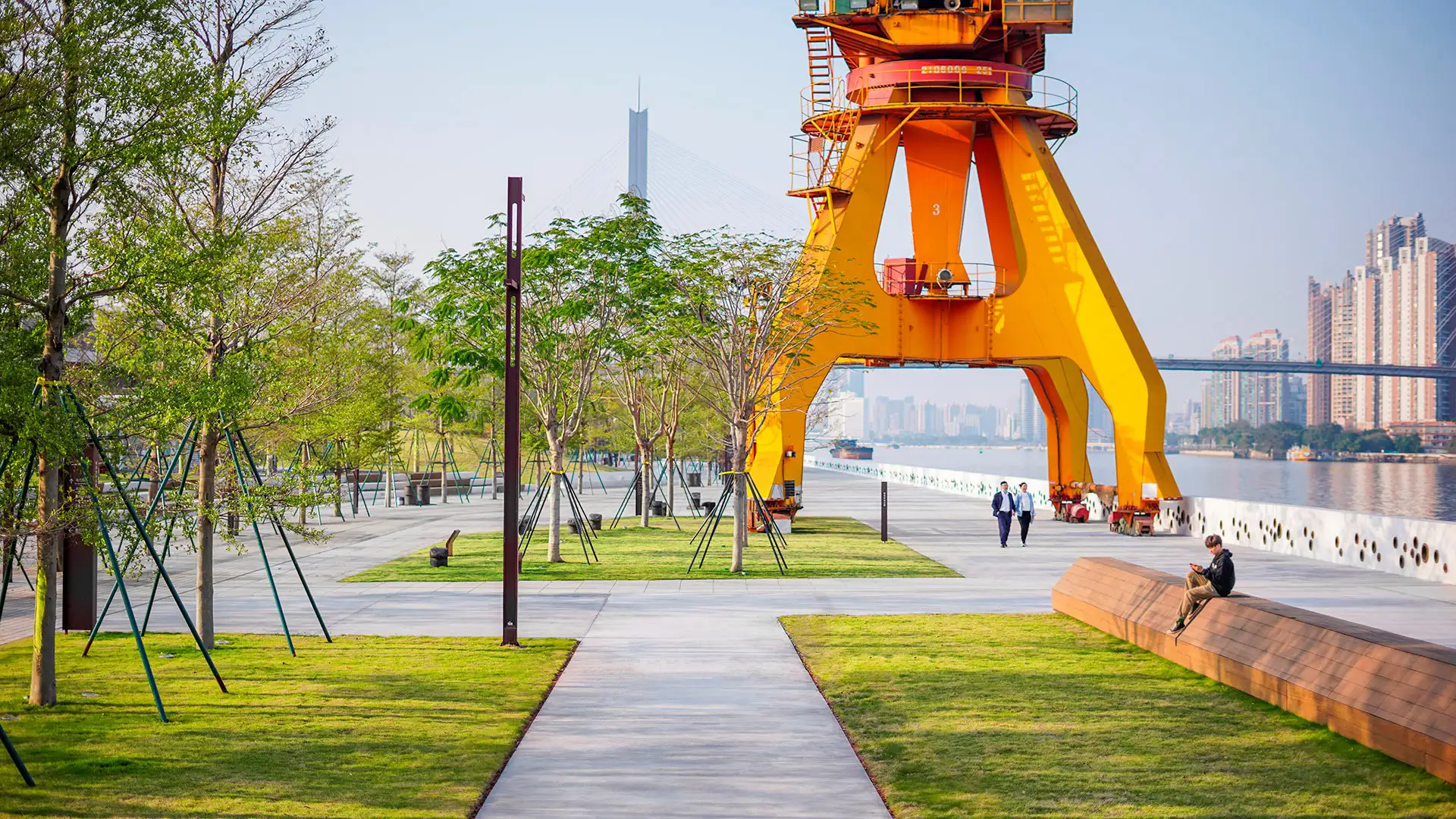


On the west bank of the Pearl River, the historic Guangzhou Shipyard has been transformed into a waterfront park that reconnects residents with the water while honoring over a century of industrial heritage. Once a Qing Dynasty fortress, the site became a shipyard in 1914 and grew into an almost 50-hectare complex—one of the earliest and most renowned in China—before the city relocated its shipbuilding industry to the suburbs in 2017. Alongside the adjacent Guangzhou Steel Factory (also designed by SWA) and the Guangzhou Paper Factory across the river, the district is now emerging as a dense urban core of housing, offices, schools, retail, and hotels.
Heritage preservation anchors the park’s identity. Three historic ship slipways, an original boat dock, and three cranes were retained and woven into the design, while industrial remnants found new life: hollowed-out ship parts became trash receptacles, bolts became benches, and gear cogs formed porthole-like openings along the flood wall. New amenities—slipway-shaped pavilions, sports fields, ship-themed playgrounds, and a pedestrian greenway—build on this layered history.
Environmental restoration was equally central. After developers capped the site’s contaminated soil, SWA introduced phytoremediation plantings—both local and adaptive species—to absorb residual pollutants, stabilize contamination, and cut costs by avoiding imported clean soil. More than 70 percent of the promenade uses permeable pavement, far exceeding Chinese policy requirements, while detention ponds, a grass swale, and rain gardens manage stormwater across the site.
Guangzhou Shipyard Park recasts an industrial legacy into a resilient, accessible riverside landscape—recognized with an Honor Award in the 2022 WLA Awards for Built Urban Design.
Aitken Place Park
Aitken Place Park is at the heart of Toronto’s East Bayfront Community – an area transformed from an underutilized industrial brownfield into a vibrant waterfront neighborhood. Flanked by the residential development to the west and the commercial buildings to the north, the park’s water’s edge location creates a unique destination that invites residents, touri...
Fuyang Riverfront
Seizing the area’s reputation for “one of the best mountain and water views in the world,” the natural framework along both sides of the Fuchun River inspires this plan integrating urban spaces with landscape to create a harmonious skyline. Fuyang flourishes with economic prosperity while honoring its vibrant cultural heritage.
The scope includes urban d...
Dubai Creek Harbor
Dubai Creek Harbor is a progressive and innovative new neighborhood that aims to respond to environmental concerns with professional, best-practice measures that will ensure an environment that is healthy, accessible, and environmentally responsible.
The storied history, culture, and nature of Dubai Creek serves as the inspiration for the design of Duba...
OCT Bao’an Waterfront Cultural Park
Bao’an Waterfront Park is an essential amenity for future residents of Shenzhen’s rapidly expanding Qianhai area, and is also an important connection between the urban fabric and the ocean. The key landscape frameworks for the park are its riverine interpretation aspects and water’s edge programs. The “Eco River” will bring water experiences into the green spa...