


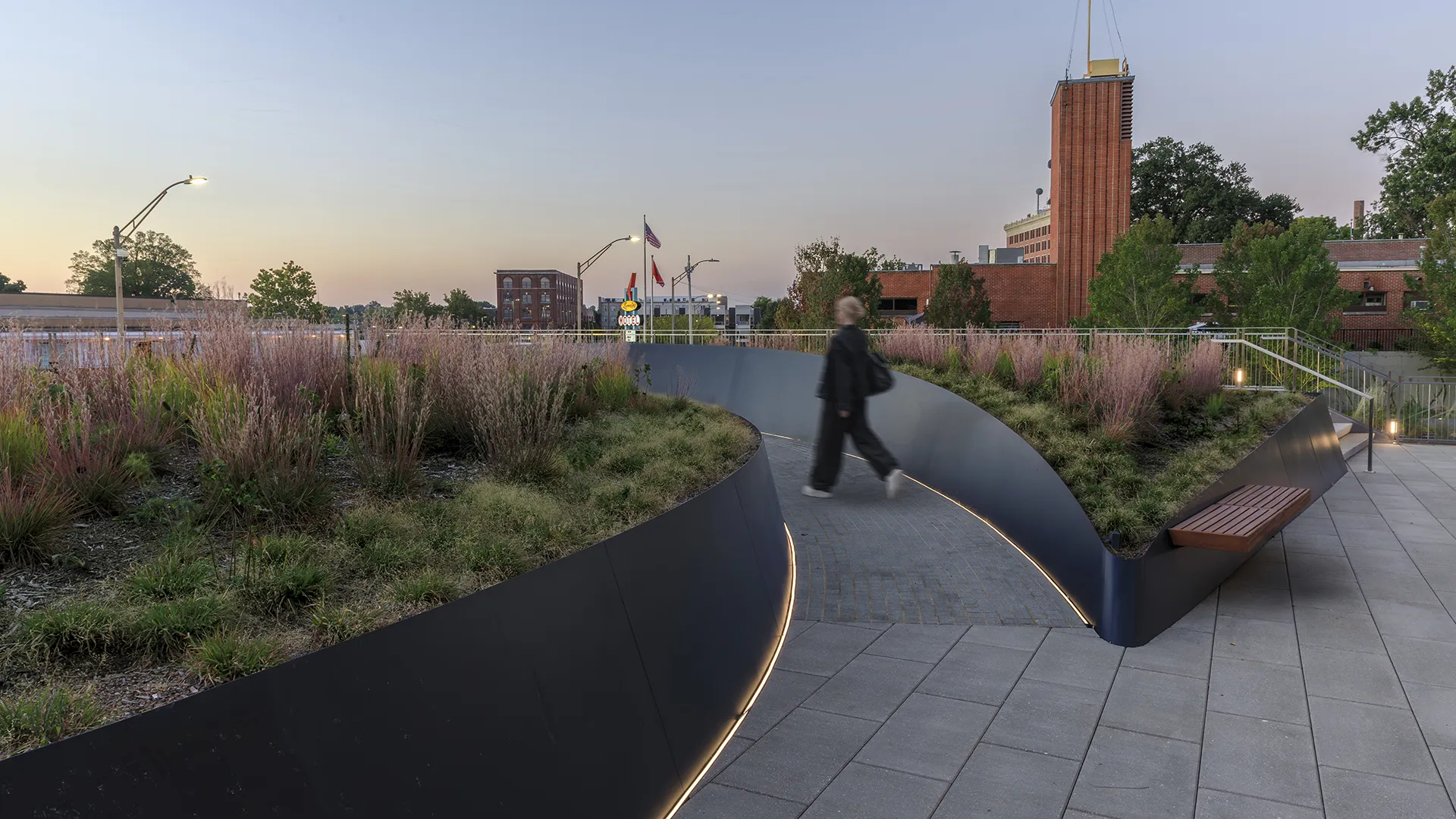


Located at the Lorraine Motel—site of Dr. Martin Luther King Jr.’s assassination on April 4, 1968—the National Civil Rights Museum serves as both a national institution and an international destination for reflection and remembrance. Led by Howard+Revis in collaboration with Self+Tucker and SWA, the west campus landscape design represents a return to a site of profound historic and cultural significance where the same team shaped the Museum’s first major expansion two decades prior.
The new phase of work expands the Museum campus with three key landscape interventions. Founders Park includes an amphitheater for performances and civic gatherings, with visual axes carefully aligned toward the Lorraine Motel balcony where Dr. King stood. Shaded “ascending rooms” provide intentional spaces for outdoor educational sessions. The Legacy Terrace, a panoramic overlook offering new vantage points of the motel balcony, features native meadow-inspired planting paired with contemplative gathering spaces organized into a flowing, curvilinear form.
The design team collaborated closely with the Museum and its steering committee to ensure that the landscape provides a powerful yet understated backdrop to the historic motel while preserving the authenticity of the site, a key step as the Museum pursues UNESCO World Heritage designation.
New entries, signage, and lighting improve connectivity and visitor experience, carefully minimizing visual clutter so that the Lorraine Motel remains the site’s defining landmark. Subtle design gestures, such as stainless steel lines embedded in paving forming a viewshed toward the balcony where Dr. King stood, acknowledge history without prescribing an interpretation of events. Seasonal planting, designed in collaboration with award-winning horticulturist Patrick Cullina, recalls the historic field conditions around the motel while providing color and bloom cycles timed to annual commemorations like MLK Day.
The Museum’s new Legacy Building and renovated Boarding House are scheduled to open in April 2026, completing this significant expansion of one of America’s most important civil rights landmarks.
Dallas Arboretum: A Tasteful Place
A year-round “food oasis” awaits visitors at A Tasteful Place, a new edible/display garden within the Dallas Arboretum. A continuation of SWA’s Arboretum work (which includes Red Maple Rill and the Children’s Garden), A Tasteful Place provides visual and hands-on education about plants and herbs that can be used in visitors’ daily cooking and explored in...
CSCEC Steel Headquarters Office and Museum
CSCEC Steel is a division of the world’s largest construction company, China State Construction Engineering Corporation Limited. CSCEC Steel is recognized as a leading global steel structure manufacturer; their projects include the CCTV Headquarters in Beijing, the Shanghai IFC, the new Abu Dhabi International Airport, and the 26th Universiade Main Stadium. To...
Norton Simon Museum
Since 1975, the Norton Simon Museum has anchored a stretch of Pasadena’s Colorado Boulevard as a defining cultural institution in Southern California. Its sculpture garden — designed by Nancy Goslee Power and modeled after the gardens at Giverny — has long shaped how visitors experience the museum, offering a quiet, green threshold before stepping inside...
Leeum Samsung Museum of Art
From its mountainside perch overlooking Seoul, the Samsung Museum of Art Complex boasts museums by three of the world’s most sought-after architects: Rem Koolhaas, Jean Nouvel and Mario Botta. Uniting these remarkable yet divergent works is an elegant, understated landscape. Complementing rather than competing with its muscular surroundings, the landscape is d...