

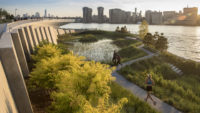
The park’s second phase, completed in 2018, offers New Yorkers an “urban wilderness;”; pathways snake along the site’s contours and between newly reintroduced wetlands and the water’s edge. Plantings engender a sense of immersion in nature.
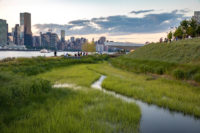
Visitors are always conscious of Manhattan’s proximity, just across the river. A dramatic, cantilevered overlook offers visitors expansive views and the perfect setting for a selfie or even a marriage proposal.

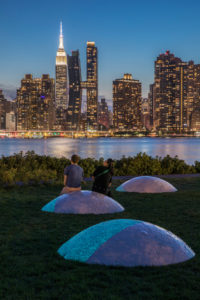
Designed in collaboration with Weiss/Manfredi, Hunter’s Point South Waterfront Park serves an ambitious adjacent affordable housing development, with more than 5,000 units in the works. The park’s full extent spans from wetlands and gabion edges designed to withstand flooding to more imaginative elements, including the overlook and the “island” featuring artist Nobu Nagasawa’s art installation.
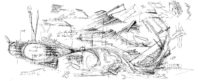
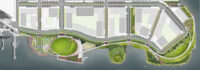
Landscape architecture, architecture, art, and engineering are fused in this extraordinary park, which was the result of a deeply collaborative process. Above: a team sketch by Thomas Balsley, Marion Weiss, and Michael Manfredi, the park’s primary authors. Arup’s engineers played a key role in the artful integration of infrastructure. The park was conceived as a whole, then approached in two phases.
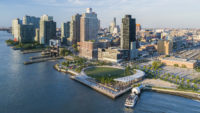
The park’s first phase, above, focused on programmed spaces and also integrated infrastructural functions. The expansive oval green, for example, serves as an athletic field for a nearby school and, during Hurricane Sandy, doubled as a retaining basin for floodwaters.
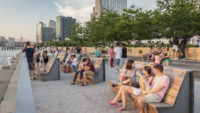
People are drawn to the water, whether to sit or to stroll….
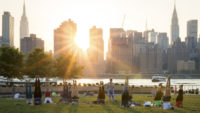
… or to engage in exercise or outdoor classes. Hunter’s Point South Waterfront Park anticipates all of this, and more.
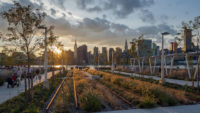
The park also nods to the site’s history, transforming former railroad tracks into garden beds.
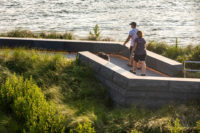
It’s an escape from the hustle and bustle of the city.
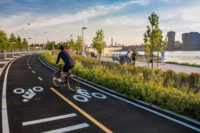
Whether a visitor is cycling by…
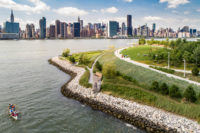
…pausing for reflection at the water’s edge…
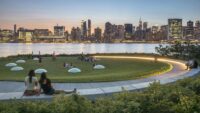
…or experiencing the magic of Luminescence, Nobuho Nagasawa’s art installation, at dusk, the park is a memorable place.
Hunter’s Point South Waterfront Park
Hunter’s Point South Waterfront Park is an international model of urban ecology and a world laboratory for innovative sustainable thinking. What was once a barren post-industrial site has been transformed into a world-class park that is both urbane and otherworldly. The site is waterfront and city; gateway and sanctuary; blank slate and pentimento. These readings suggest an approach to the landscape that enhances what is unique about the site, while framing a new multi-layered identity as a recreational and cultural paradigm.
A collaboration among Thomas Balsley Associates and WEISS/MANFREDI for the open space and park design, with ARUP as the prime consultant and infrastructure designer, the project’s innovative and sustainable design strategies weave infrastructure, landscape, and architecture into new open spaces with connections to the surrounding communities. The park provides access to the water’s edge and spectacular views of the Manhattan skyline.
Designed by Thomas Balsley while at Thomas Balsley Associates, together with WEISS/MANFREDI and ARUP.
LOCATION Queens, New York, United States
CLIENT Port Authority
SCOPE Master Planning, Landscape Architecture
PRESS:
Hunter’s Point South Wins ULI Americas Award of Excellence
The Best New York City Architecture of the Past Decade
New York’s Newest Park Redeems a Wasteland
10 Fun Facts About Hunter’s Point South Waterfront
“We actually celebrate the kind of crazy shoreline that we were given. We leveraged its peninsulas into an extraordinarily different kind of waterfront experience, one that allows people to wander in and out, going closer to the water and back away from it. Those shifting perspectives … are really only possible with this kind of diverse shoreline.”
– Tom Balsley, SWA/Balsley
Shunde Guipan River Waterfront
SWA participated in a competition reimagining 19-kilometers of the Guipan River waterfront in Shunde, China. While the Pearl River Delta is one of the fastest growing regions of Southern China, one of the many casualties of this growth was the delta itself. Presently, Shunde has a growing flooding problem enhanced by channelizing, condensing, and containing th...
Longgang River Blueway System
The Shenzhen Longgang River Blueway System is envisioned to unlock the tremendous land value of this 13-mile-long suburban watershed and galvanize the city’s future growth. SWA’s proposal addresses urbanization issues pertaining to water, the environment, and open space shortage, while also activating industrial and cultural revitalization in the surrounding d...
Hengqin Island
Hengqin Island, located in Zhuhai, China, is embedded within a unique and beautiful landscape, and is currently being developed for urban growth throughout the region. Taking cues from the surrounding site, SWA’s master plan intends to capture the essence of the place, and pay homage to its most fundamental landscape elements: the sea, valley, and mountains. S...
San Jacinto Plaza
SWA’s redesign of San Jacinto Plaza, a historic gathering place in El Paso’s downtown business district provides a state-of-the-art urban open space, while protecting and celebrating the history and culture of the site. The project was the result of an intensive community process involving input from a wide range of constituents. Active programming, environmen...