

Impactful Landscapes:
11 award-winning
SWA projects
What makes for exemplary work when your medium is landscape? Eleven SWA projects have been singled out with awards by the American Society of Landscape Architects (ASLA) in 2021– two of them with high honors at the national level.
The work demonstrates how landscape, urban design and planning improvements can offer cities and communities important opportunities to leverage more value from public investment. Well-designed outdoor amenities, like waterfronts and parks, can simultaneously address issues of restorative justice, resilient infrastructure, and climate change—some of the most pressing challenges of our time.
SWA creates beautiful and performative public realm spaces that make cities more livable and resilient.
ASLA National Award Winners
Repairing the Rift
Ricardo Lara Linear Park, Lynwood, CA
ASLA Urban Design Award of Excellence


Ying-yu Hung
Managing Principal
“Ricardo Lara Linear Park is a vibrant community park that offers vital open space and recreational amenities for an area that has suffered from urban blight for many decades. It fills a void and begins to address the uneven distribution of open spaces in Southern California’s underserved communities.”
This transformative landscape offers healing both physical and metaphorical for an underserved community fragmented by freeway infrastructure. Here, a derelict freeway-adjacent right of way has been artfully recast as a 5.25-acre, five-block linear park, with recreational amenities and gathering spaces for the approximately 26,000 people who live within a half-mile walking distance. The park’s programming focuses on exercise, education, and play, while its bold, gestural design reinforces the neighborhood’s unique vitality.
Today, the park serves to repair the history of discriminatory development and celebrate a growing community’s vibrant future.
A People’s Plan for Freedom Park
Freedom Park, Atlanta, GA
Honor Award, Analysis and Planning


Natalia Beard
Principal
“Freedom Park is a national treasure… Its design reflects critical timely issues: reclaiming infrastructure for urban nature, convening communities by providing a civic platform, and framing cultural-historic narratives for just and inclusive public space. We look forward to the seeing the park come to life with all its potential!”
Atlanta’s Freedom Park, a 130-acre-swath of land cleared for a proposed (and ultimately aborted) highway, was born from grass-roots protest and civil disobedience nearly thirty years ago. Its origin story of civic action is both palpably local and nationally resonant, involving leaders such as Martin Luther King and the late Congressman John Lewis among others. The master plan for the park’s future is informed by intense community involvement, with the ambition of repositioning the park from its presence as a proud scar into a more potent connective tissue—one that offers an equitable, culturally rich and civic-minded common ground for Atlanta and the nation.
Regional Awards: Waterfronts

Grey to Green: Enlivening an Industrial Waterfront
Nantong Riverfront Landscape Planning and Design, Nantong, China
ASLA Southern California Chapter Merit Award
SWA’s master plan resurrects this industrial site on the Yangtze River into a resilient waterfront park. Central to the approach is a redesign of the embankment, raising it to 100-year flood standards and transforming it from a hard, engineered edge to a series of natural revetments—wetland islands, sloping gardens, hydrophilic terraces, and waterfront trails—that offer a variety of experiences while also promoting resiliency. Industrial relics are preserved and reused throughout the site as a nod to the site’s history as the region’s growth engine. The plan seeks to celebrate the site’s industrial past, improve ecological performance, reconnect locals to the water, and provide greater security from increasingly common flood events so that the resulting Nantong Riverfront can be a place of great historical significance and modern-day enjoyment.
A New Line in the Sand
Santa Monica North Beach Trail, Santa Monica, CA
ASLA Southern California Chapter Merit Award
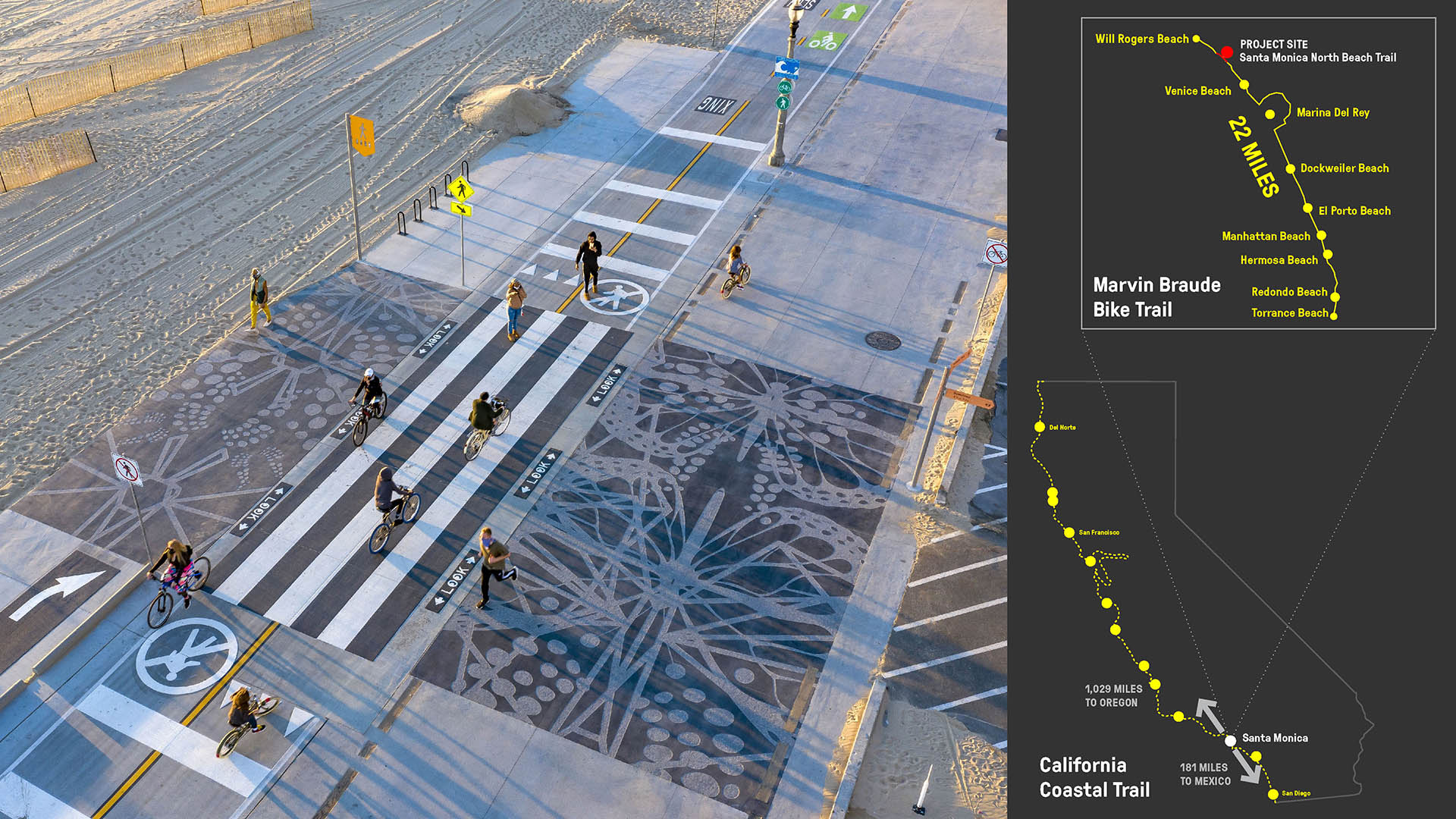
While Santa Monica’s iconic beaches draw thousands of tourists per year, the trails that run through them are a big attraction for locals, for whom they provide exercise, relaxation, and a more inviting commute than Los Angeles County’s congested freeways. Yet the trails were also run-down and congested, with increasing pedestrian-cyclist conflicts. This beachfront improvement prioritizes safety, separating lanes out for pedestrians, while also using design to reveal the city’s history and ecology. The nearly mile-long trail borders residences, bike rental sheds, beach cafés, and parking areas has been animated with enhanced paving that doubles as wayfinding and place-making. Intersections, formerly pedestrian and bike-traffic “choke points,” are now marked by distinctive artwork that is visible upon approach by users at all speeds. Each crossing serves not only as a safety feature, but also as a destination and meeting place, and with pattern design expressive of the region’s native species.

Reclaiming an Industrialized Waterfront
Nelson Mandela Park Master Plan, Rotterdam, Netherlands
ASLA New York Chapter Merit Award
SWA/Balsley’s Master Plan for Nelson Mandela Park envisions a new, much-needed central neighborhood and civic open space in Rotterdam’s South Maashaven district, home to a growing and increasingly diverse population. The planning process engaged the community and embraced a holistic approach to waterfront site, celebrating its maritime history and reclaiming land lost to the sea. A naturalized shoreline, marsh habitats, multi-purpose lawns, tree groves, and sculpted knolls and overlooks are introduced to offer natural relief– a counterpoint to the otherwise industrialized setting. The park’s edge will align with the new levee promenade along the adjacent, prominent Pretorialaan commercial boulevard creating a welcoming gateway for the regular stream of everyday users. Access to public transit invites diverse groups from far and wide to gather and engage.
Regional Awards: Parks

A Livability Magnet
Dongguan Central Park, Dongguan, China
ASLA Northern California Chapter Award of Merit – Analysis and Planning
This new 32-hectare park is envisioned as a “livability magnet” in the ongoing renewal of the Dongguan’s Central Business District, intended to attract new talent to the reputed “world’s factory.” SWA conceptualized the park as a living system, inspired by the durable, growing roots of a banyan tree. The design leverages thoughtful strategies for soil, water, and planting to help establish habitat, while drawing on local materials to reinforce cultural identity and sense of place. Setting a new standard for urban outdoor experience, Dongguan Central Park Area will offer an adaptable, all-day social and recreational attraction for both long-established residents and new workers to its thriving industrial base.

Green Infrastructure + Public Realm Placemaking
Markham Square, Conway, AR
ASLA Texas Chapter Merit Award
This ambitious, holistic plan deploys green infrastructure techniques in creating an unparalleled public space, transforming a brownfield site plagued by flooding into a lively stormwater park and cultural asset for the city. Markham Square embraces green infrastructure and play, biodiversity and community, stormwater management and recreation; all are inseparable and complementary aspects of the built environment. This approach enables access to EPA funding though the full aspirational vision will require additional fundraising. This conscious decision by the City of Conway and the landscape architecture team stems from a shared conviction that 21st century green infrastructure projects offer more than just ecological function; public projects that invite human experiences and encourage appreciation for natural systems are essential to fostering a culture of care in which local landscapes are collectively valued and stewarded.

Raising the Green Bar
Panyu Central Park, Guangzhou, China
ASLA Southern California Chapter Merit Award
Panyu Central Park is the new hub of Guangzhou’s booming central business district, setting a new standard for public open space. SWA’s design offers a memorable place of natural respite that also functions as green infrastructure. The park’s sculped terrain, rain gardens, trails and gathering spaces offer visitors a variety of passive and programmed experiences, with design also facilitating rain water collection, reuse and ground water recharge.
Regional Awards: Residential
Everyone Deserves a Garden
Ping Yuen Public Housing Rehabilitation, San Francisco, CA
ASLA Northern California Chapter Merit Award
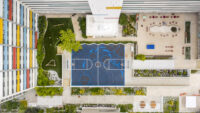
SWA’s landscape renovation of Ping Yuen, the first public housing development in San Francisco’s Chinatown, replaces a fortress-like setting with plantings and outdoor improvements that invite residents to enjoy a breath of fresh air. The redesign’s planting palette is a sophisticated combination of cultural and local texture, drawing upon California native plants and traditional Asian garden species. Spurred by the Chinatown Community Development Center, improvements enable longed-for access to private open space and its associated health benefits to the development’s approximately 434 lower-income families.
Restorative Nature
SunCity Tachikawa Showa Kinen Koen, Tachikawa, Japan
ASLA Northern California California Chapter Award of Excellence
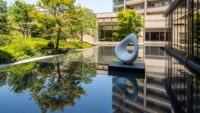
This lush landscape for a premium continuum-of-care retirement community aims to leverage the healing qualities of the natural environment, and takes its name and design cues from the adjacent Koen National Park. Here, residents of the 501 independent living units and 91 nursing units are surrounded by nature. Ambulatory residents and their guests can stroll in the large garden, and all have visual access to the central garden which features a water cascade, a reflecting pool, and an enclosed bridge connecting the major wings of the first-floor public areas. A small, formal healing garden provides seating areas shaded by vine-covered pergolas, offering peaceful respite for elders and their families.
Regional Awards: Communication

Communicating Coastal Edge Strategies
Resilience Cards
ASLA Southern California Chapter Communication Award
These 10 double-sided, playing-cards feature infographics on coastal edge treatments, illustrating the nuances of different typological strategies that represent current best practices in resilience planning and design. Easily transferrable in both digital and printed media, the cards explain key considerations that differentiate various approaches — including each technique’s pros and cons, cost considerations, materiality, effectiveness, spatial distribution, and an overall resiliency score — in a readily understandable graphic format. Each features an axonometric drawing of the particular typology on the front, depicting either an object- or landscape-based strategy, as well as key metrics.