

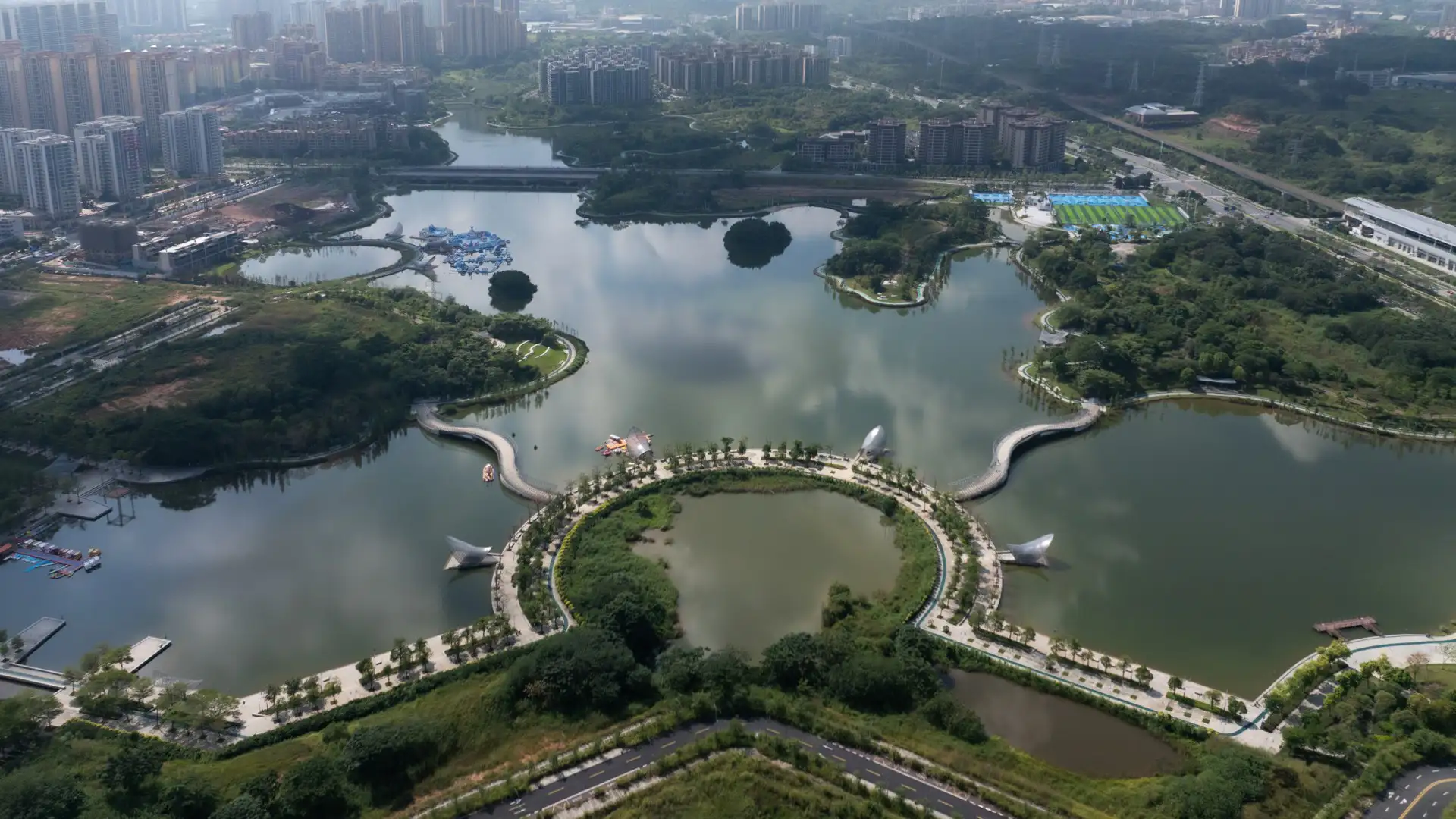


Located in Shishan Town, Foshan, the 136-hectare BoAi Lake site began as a freshwater reservoir before being subdivided into a patchwork of aquaculture fish ponds. This fragmentation broke hydrologic continuity, isolated habitats, and cut the public off from the water’s edge. Bounded by emerging mixed-use development to the north and preserved forest to the south, the site called for a design that could unify these disconnected systems into a single civic waterfront.
SWA’s approach treats the lake as climate infrastructure rather than a passive amenity, merging flood control, habitat restoration, and recreation into one continuous framework. Stabilizing water levels and reconstructing the shoreline consolidated the former ponds into a contiguous lake capable of supporting ecological performance and public life together.
A layered waterfront—promenades, bridges, hillside trails, wetlands, plazas, and event terraces—creates uninterrupted circulation while offering multiple vantage points along the shore. The urban edge reads as a tree-lined community frontage, while the forest edge softens into wetlands, reforestation zones, and habitat islands, establishing a clear gradient from city to nature.
Multi-elevation promenades and flood-tolerant lawns allow the landscape to absorb seasonal fluctuation without structural failure, and a distributed system of wetland benches, treatment wetlands, and bioswales filters stormwater while making ecological processes visible to visitors. Balanced earthwork, reused on-site soils, and planted living edges replace rigid retaining structures, prioritizing material efficiency and long-term resilience.
Roughly 22 hectares of reforestation and wetland planting support carbon sequestration and biodiversity, while continuous canopy cover shades promenades against Foshan’s humid climate. Signature bridges, pavilions, and overlooks anchor the site’s identity—now known locally as the “living room of Shishan,” home to dragon boat races and lantern festivals. What was once fragmented aquaculture infrastructure now functions as a resilient, ecologically connected civic landscape.
Aitken Place Park
Aitken Place Park is at the heart of Toronto’s East Bayfront Community – an area transformed from an underutilized industrial brownfield into a vibrant waterfront neighborhood. Flanked by the residential development to the west and the commercial buildings to the north, the park’s water’s edge location creates a unique destination that invites residents, touri...
Rio 2016 Olympic Park Competition
SWA was awarded 2nd place in the 2016 Olympic Park Competition in Rio de Janeiro for their master plan and landscape architecture proposal. The Olympics will be located on a 118-hectare site in the neighborhood of Barra da Tijuca. The underlying concept of ‘Embrace’ weaves through the design in a grand planning gesture, which both defines the Olympic Games and...
OCT Bao’an Waterfront Cultural Park
Bao’an Waterfront Park is an essential amenity for future residents of Shenzhen’s rapidly expanding Qianhai area, and is also an important connection between the urban fabric and the ocean. The key landscape frameworks for the park are its riverine interpretation aspects and water’s edge programs. The “Eco River” will bring water experiences into the green spa...
San Diego Embarcadero
The redevelopment plan for the waterfront and port facilities adjacent to downtown San Diego included translating community and economic requirements into a specific planning program. Emphasis was placed on urban design, circulation and parking, landscaping, environmental planning, and engineering considerations with a set of comprehensive implementation guide...