

Publications
Access to quality public outdoor spaces is a major indicator of a community’s socioeconomic health. Our approach to designing these spaces integrates ecology, mobility, infrastructure, and programming and activation strategies to enrich the lives of their users, and provide lasting value for generations to come.

SWA Works: Landscapes for People
Landscape architecture has revolutionized over the past decade, with concerns over sea-level rise, alternative transit, water quality, and social equity key issues that SWA addresses daily. With seven billion people in the world, the pressure is on to create unique open space systems that integrate aesthetics and programming with sustainability, nature, and economics. This monograph details SWA’s unique approach in four primary categories: Urban Regeneration, Creative Campus, Lifestyle, and Adaptive Strategies.

Landscape Infrastructure
The future of infrastructure no longer belongs solely to engineers and transportation planners. The rapid pace of change in cities and towns means that multidisciplinary teams of landscape architects, environmental planners, and architects work with scientists and engineers to fully realize the wide-ranging benefits possible along underutilized highway and railway corridors, rooftops, floodplains, and other human-made and natural corridors. All case studies include technical diagrams and plans for repositioning infrastructure to address issues of recreation, transit, and habitat.

Designing Places for People and the Environment
Part autobiography, part firm history, and a window into the future of urban design, this title presents lessons learned from 55 years of experience in urban design and planning. SWA Group’s first president uses 35 case studies drawn from his personal history and portfolios of SWA’s iconic work to detail the business and professional practices that allow it to plan, design, and build livable and sustainable communities where people can live in dignity, with health and happiness.

Thomas Balsley: Uncommon Ground
New York-based landscape architect Thomas Balsley, managing principal of SWA/Balsley, has driven the design and creation of some of the most notable and awarded spaces internationally and throughout the U.S., including the recently opened Hunter’s Point South Waterfront Park in Long Island City, New York. This volume collects selected Balsley projects that display the sweeping range of his work over the past 25 years.

Selected Works of Landscape Architect John L. Wong
This monograph presents a comprehensive overview of a Landscape Architecture career spanning more than four decades: the life’s work of John L. Wong. The featured works were created in collaboration across diverse cultures and countries, employing a vast range of concepts and exploring the whole spectrum of possibilities, from crafting small gardens to planning large-scale neighborhoods, towns and new communities. John L. Wong’s prolific body of work is global with focal points in North America, the Middle East, and Asia, especially Japan, Korea and China.

Atlas of Infrastructure Adaptation
“Atlas of Infrastructure Adaptation” documents how cities around the world are transforming transportation infrastructure into multifunctional public landscapes. The Atlas draws from more than a decade of applied research and features over 250 global precedent projects alongside fifteen in-depth case studies exploring new approaches to ports, rivers, railways, and roads.
Playbook for the Pyrocene
Building on years of wildfire-related research in Paradise and Sonoma County, California, as well as helping shape the state’s overall wildfire planning guide, “Playbook for the Pyrocene” is a practical manual for design professionals, agencies, and landowners to rethink how we design and build communities in a fire-prone world. In particular, the project focuses on filling knowledge gaps—synthesizing information from fire science, forestry, land use planning, and emergency management to provide guidance across a range of project types, scales, and contexts.
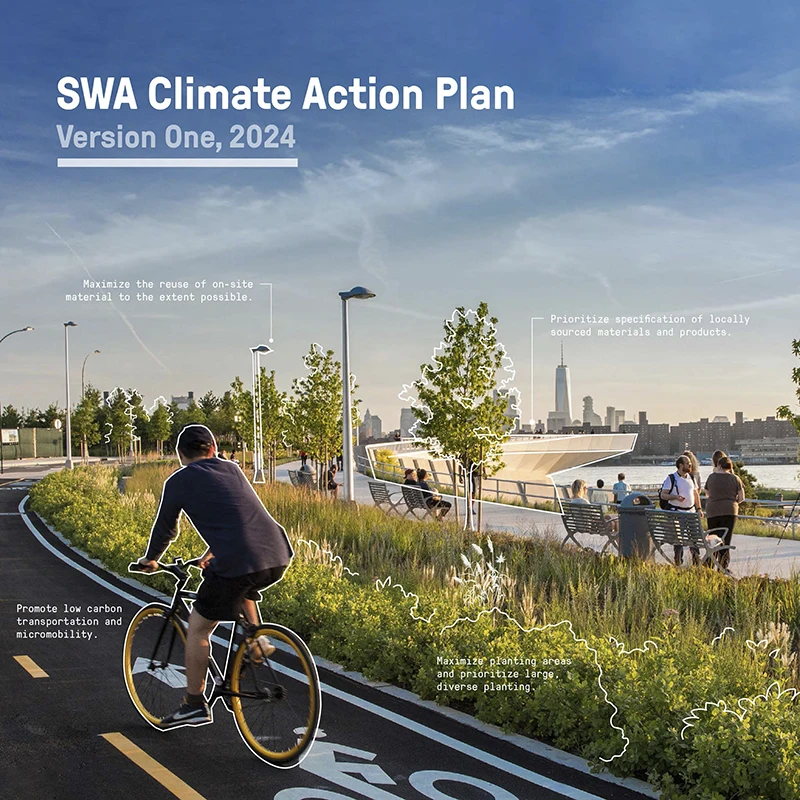
Climate Action Plan
The first landscape architecture firm to develop a Climate Action Plan of this kind, this report outlines SWA’s strategy to tackle both project and operational emissions in alignment with ASLA and IPCC goals. Targeting a 50% reduction in emissions by 2030, SWA plans on incorporating decarbonization design strategies and carbon accounting workflows throughout the firm’s project work.
Field Guide to Life in Urban Plazas
Reconsidering William H. Whyte’s Street Life Project and seminal study The Social Life of Small Urban Spaces (1980), “Field Guide to Life in Urban Plaza” sought to understand how public spaces have changed some 40 years on. The guide looked at 10 plazas in Manhattan by 10 different designers, constructed or renovated in the last 15 years, using new analytical tools to develop heat maps describing dwell time, frequent and infrequent usage, and preliminary pedestrian counts. The goal was to identify common behavior patterns, collective activity, programming, physical elements, and understand context across the sites in order to inform future public realm design.