Climate

Infrastructure:
As a whole, the built environment accounts for immense embodied and operational greenhouse gas emissions, while being overwhelmingly vulnerable to the effects of climate change. Mitigation & Adaptation

Explore these strategies in the four portfolios below. SWA identified 19 strategies to enable landscape architects, urban designers, planners and clients to shrink the carbon footprint of the built environment and help communities adapt to the effects of climate change. 19

1: FLATTEN EMISSIONS

Limit the amount of greenhouse gases emitted during a project’s entire life cycle.
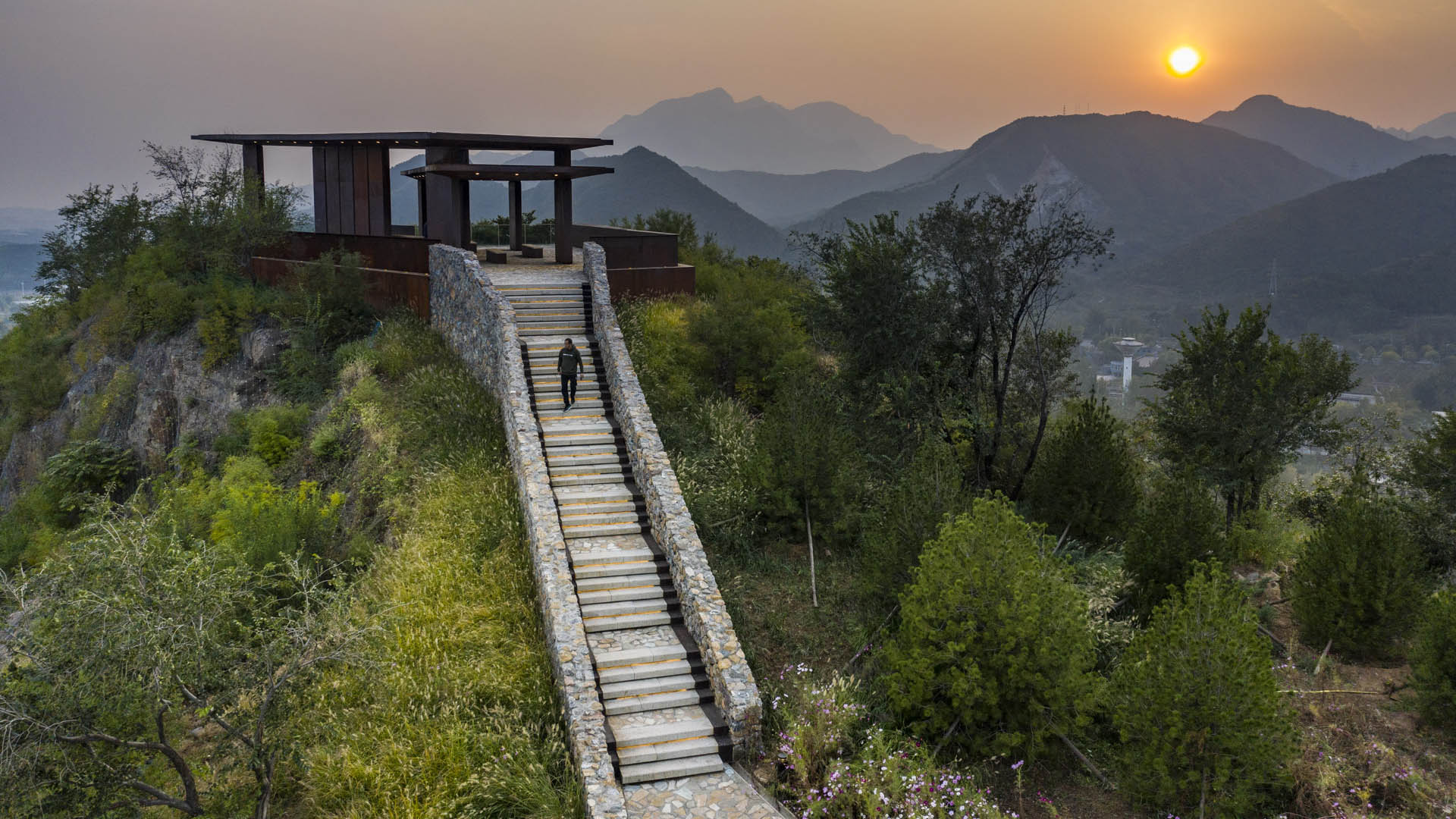
Even before a project is built, the manufacturing, transportation, and construction of materials contribute to its embodied carbon. This can be reduced by sourcing materials locally, reusing on-site materials, or choosing materials that require less intensive manufacturing. Beijing Quarry Park, Beijing, China During initial site analysis of this formerly active stone quarry, SWA worked with local geologists to identify more than 250,000 cubic meters of rock material available for reuse as pathways and retaining walls. Additionally, heavy machinery was left on site, and incorporated into the park as sculptural elements—adding historical texture while eliminating the need for carbon-intensive removal. 1.1 Minimize Embodied Carbon Operational carbon emissions are typically linked to the energy required to operate and maintain a site over time. The installation of green roof systems atop structures can improve building energy performance by moderating heat flow. Additional operational carbon can be mitigated by pursuing design solutions that require less intensive maintenance like mowing. Giant Interactive Group, Shanghai, China As part of a 45-acre campus in Shanghai, SWA designed a sprawling 3.5-acre green roof system above the main headquarter building. The green plant-rich roof is large enough to create its own microclimate, and helps offset peak energy demand by stabilizing daily temperatures. The use of both native and adapted plant species, configured to optimize solar orientation and local water availability, reduces daily maintenance requirements, further mitigating operational carbon emissions. 1.2 Reduce Operational Energy Gas-powered vehicles are a major contributor to global GHG emissions. These emissions can be lowered by reducing dependence on vehicular transportation through improved walkability and bikeability. Additionally, designers can integrate micro-mobility services such as e-bikes and/or charging stations for electric vehicles. Katy Trail, Dallas, Texas In a metro area historically dominated by vehicular transportation infrastructure, SWA converted an abandoned rail bed into a 3.5-mile multi-use trail that now provides local residents with access to alternative mobility options. The trail, which connects residential neighborhoods with local businesses and outdoor recreation areas, is used by more than 1.5 million people per year, and will eventually be connected to a larger regional trail network. 1.3 Enable No-Engine Mobility Provision of renewable energy systems as alternatives to fossil fuels is essential for meeting net-zero emissions goals. Photovoltaics, wind turbines, geothermal heat pumps, and biogas systems, among other technologies, can be used to power buildings, maintenance equipment, and other site operations... and, if planned correctly, can produce more energy than they consume. This surplus can then supplement the grid, helping to support larger-scale energy transitions. UC Davis West Village, Davis, California Designed to house over 3,000 students, faculty, and university affiliates, this 200-acre residential neighborhood on the University of California Davis campus generates nearly 6 million kilowatt hours (kWh) of electricity from photovoltaic panels installed on rooftops and above parking lots. This electricity is consumed directly by neighborhood residents and maintenance facilities, meeting more than 80% of the total on-site demand. 1.4 Power With Renewables The conversion of undeveloped areas to more intensive land uses results in large amounts of GHG emissions. Reusing urban land, and leveraging its connections to existing infrastructure for new development, can dramatically decrease a project’s overall carbon footprint. Urban infill projects and adaptive reuse of existing structures and sites are prime examples of this approach. Woodbine Racetrack Master Plan, Toronto, Canada Since 1956, Woodbine Racetrack has been operated exclusively for thoroughbred racing. However, in order to meet the rising demand for jobs and housing, the 684-acre site in the heart of northwest Toronto will be reimagined as a city within a city, integrating new uses without the need for carbon-intensive greenfield development. The vision includes housing for 60,000 new residents and a new public transit station. 1.5 Repurpose Urban Land

Even before a project is built, the manufacturing, transportation, and construction of materials contribute to its embodied carbon. This can be reduced by sourcing materials locally, reusing on-site materials, or choosing materials that require less intensive manufacturing. Beijing Quarry Park, Beijing, China During initial site analysis of this formerly active stone quarry, SWA worked with local geologists to identify more than 250,000 cubic meters of rock material available for reuse as pathways and retaining walls. Additionally, heavy machinery was left on site, and incorporated into the park as sculptural elements—adding historical texture while eliminating the need for carbon-intensive removal. 1.1 Minimize Embodied Carbon Operational carbon emissions are typically linked to the energy required to operate and maintain a site over time. The installation of green roof systems atop structures can improve building energy performance by moderating heat flow. Additional operational carbon can be mitigated by pursuing design solutions that require less intensive maintenance like mowing. Giant Interactive Group, Shanghai, China As part of a 45-acre campus in Shanghai, SWA designed a sprawling 3.5-acre green roof system above the main headquarter building. The green plant-rich roof is large enough to create its own microclimate, and helps offset peak energy demand by stabilizing daily temperatures. The use of both native and adapted plant species, configured to optimize solar orientation and local water availability, reduces daily maintenance requirements, further mitigating operational carbon emissions. 1.2 Reduce Operational Energy Gas-powered vehicles are a major contributor to global GHG emissions. These emissions can be lowered by reducing dependence on vehicular transportation through improved walkability and bikeability. Additionally, designers can integrate micro-mobility services such as e-bikes and/or charging stations for electric vehicles. Katy Trail, Dallas, Texas In a metro area historically dominated by vehicular transportation infrastructure, SWA converted an abandoned rail bed into a 3.5-mile multi-use trail that now provides local residents with access to alternative mobility options. The trail, which connects residential neighborhoods with local businesses and outdoor recreation areas, is used by more than 1.5 million people per year, and will eventually be connected to a larger regional trail network. 1.3 Enable No-Engine Mobility The conversion of undeveloped areas to more intensive land uses results in large amounts of GHG emissions. Reusing urban land, and leveraging its connections to existing infrastructure for new development, can dramatically decrease a project’s overall carbon footprint. Urban infill projects and adaptive reuse of existing structures and sites are prime examples of this approach. UC Davis West Village, Davis, California Designed to house over 3,000 students, faculty, and university affiliates, this 200-acre residential neighborhood on the University of California Davis campus generates nearly 6 million kilowatt hours (kWh) of electricity from photovoltaic panels installed on rooftops and above parking lots. This electricity is consumed directly by neighborhood residents and maintenance facilities, meeting more than 80% of the total on-site demand. 1.4 Power With Renewables The conversion of undeveloped areas to more intensive land uses results in large amounts of GHG emissions. Reusing urban land, and leveraging its connections to existing infrastructure for new development, can dramatically decrease a project’s overall carbon footprint. Urban infill projects and adaptive reuse of existing structures and sites are prime examples of this approach. Woodbine Racetrack Master Plan,
Toronto, Canada
Since 1956, Woodbine Racetrack has been operated exclusively for thoroughbred racing. However, in order to meet the rising demand for jobs and housing, the 684-acre site in the heart of northwest Toronto will be reimagined as a city within a city, integrating new uses without the need for carbon-intensive greenfield development. The vision includes housing for 60,000 new residents and a new public transit station. 1.5 Repurpose Urban Land
XL Logo climate bill colors

2: SEQUESTER CARBON

Capture, absorb, and store as much atmospheric carbon as possible.

Projects that prioritize the conservation of undeveloped lands by consolidating built elements can help optimize the natural process by which plant material and soils naturally sequester and store carbon. Additional gains can be made by working with clients to create long-term land use guidelines and management plans. Golden Gate National Recreation Area, Northern California Situated within a metropolitan area of more than 7.5 million people, this 90,000-acre park was comprehensively analyzed and inventoried by SWA. The firm assessed natural, social, and cultural resources, and made recommendations for strategic land conservation and management. Today, the area sequesters more than 75,000 metric tons of CO2 annually. 2.1 Preserve Undeveloped Land As part of their natural biological cycle, plants absorb carbon dioxide, store it as biomass, and lock it into the soil through their roots. Planting dense, multi-layered vegetation - especially fast-growing, and long-living species - can effectively increase the amount of carbon sequestered on a site. DNP Ichigaya Forest, Tokyo, Japan SWA’s Ichigaya Forest project transformed more than half of the 13 acres of landscape area exposed by the consolidation of this printing company’s production facility site into a dense, multi-layered stand of native trees and shrubs. The project creates a unique urban forest in central Tokyo, with the capacity to sequester as much as 120 tons of CO2 annually once its plants are fully mature. 2.2 Plant Dense Vegetation Soil naturally absorbs atmospheric carbon and stores it underground; digging and other disturbances release that carbon back into the atmosphere. Minimizing earthwork on a site, on the other hand, helps to immobilize terrestrial carbon below-ground. This can be achieved by elevating structures, consolidating development footprints, and limiting cut/fill operations. OCT Guangming Trail, Shenzhen, China This six-kilometer trail system, which includes three major design nodes, demonstrates the delicate intersections between ecology and technology. The design elevates the trail where it comes into contact with the site’s major topographical changes... leaving the soil below—with its large reserves of terrestrial carbon—undisturbed. 2.3 Minimize Soil Disturbance Wetland soils are among the planet’s most effective carbon sinks. By creating, repairing, and encouraging the expansion of wetland ecosystems—including mangroves, marshes, peat bogs, and swamps—designers can dramatically improve a site’s carbon sequestration capacity. Wuhan East Lake, Wuhan, China Known as the “land of one thousand lakes” and home to more than 11 million people, Wuhan has become central China’s dominant transportation hub. To offset some of this megacity’s GHG emissions, SWA reexamined its vast network of waterways, rivers, and lakes. The new park and conservation area expands wetlands and deep marshes throughout the country’s largest urban lake, providing important recreational amenities while increasing the region’s carbon-capture capacity. 2.4 Regenerate Wetlands

Projects that prioritize the conservation of undeveloped lands by consolidating built elements can help optimize the natural process by which plant material and soils naturally sequester and store carbon. Additional gains can be made by working with clients to create long-term land use guidelines and management plans. Golden Gate National Recreation Area, Northern California Situated within a metropolitan area of more than 7.5 million people, this 90,000-acre park was comprehensively analyzed and inventoried by SWA. The firm assessed natural, social, and cultural resources, and made recommendations for strategic land conservation and management. Today, the area sequesters more than 75,000 metric tons of CO2 annually. 2.1 Preserve Undeveloped Land As part of their natural biological cycle, plants absorb carbon dioxide, store it as biomass, and lock it into the soil through their roots. Planting dense, multi-layered vegetation - especially fast-growing, and long-living species - can effectively increase the amount of carbon sequestered on a site. DNP Ichigaya Forest, Tokyo, Japan SWA’s Ichigaya Forest project transformed more than half of the 13 acres of landscape area exposed by the consolidation of this printing company’s production facility site into a dense, multi-layered stand of native trees and shrubs. The project creates a unique urban forest in central Tokyo, with the capacity to sequester as much as 120 tons of CO2 annually once its plants are fully mature. 2.2 Plant Dense Vegetation Soil naturally absorbs atmospheric carbon and stores it underground; digging and other disturbances release that carbon back into the atmosphere. Minimizing earthwork on a site, on the other hand, helps to immobilize terrestrial carbon below-ground. This can be achieved by elevating structures, consolidating development footprints, and limiting cut/fill operations. OCT Guangming Trail, Shenzhen, China This six-kilometer trail system, which includes three major design nodes, demonstrates the delicate intersections between ecology and technology. The design elevates the trail where it comes into contact with the site’s major topographical changes... leaving the soil below—with its large reserves of terrestrial carbon—undisturbed. 2.3 Minimize Soil Disturbance Wetland soils are among the planet’s most effective carbon sinks. By creating, repairing, and encouraging the expansion of wetland ecosystems—including mangroves, marshes, peat bogs, and swamps—designers can dramatically improve a site’s carbon sequestration capacity. Wuhan East Lake, Wuhan, China Known as the “land of one thousand lakes” and home to more than 11 million people, Wuhan has become central China’s dominant transportation hub. To offset some of this megacity’s GHG emissions, SWA reexamined its vast network of waterways, rivers, and lakes. The new park and conservation area expands wetlands and deep marshes throughout the country’s largest urban lake, providing important recreational amenities while increasing the region’s carbon-capture capacity. 2.4 Regenerate Wetlands
XL Logo climate bill colors

3: MODULATE EXCESS

Establish barriers against extreme, climate-driven forces including excess heat, rain, wind, and wildfire.

Warming oceans and rising sea levels are both contributing to increased frequency and intensity of coastal storm events, which threaten hundreds of millions of people globally. Exposure to these storm events can be reduced by establishing dense wetland buffer zones and by integrating riprap or other hard infrastructure along coastal edges. Hunter’s Point South Waterfront Park, Queens, New York This 9.5-acre waterfront park was planned and designed to withstand frequent flooding along New York City’s East River. The park combines hard and soft coastal edges, including 760 feet of continuous gabion walls and bulkheads along with bioswales and vegetated buffers that are designed to protect nearby neighborhoods from flood waters. Riprap piles and marsh plantings work to further armor the shoreline and subdue harsh waves during storm events. 3.1 Limit Coastal Storm Exposure As a result of climate change, naturally fire-adapted landscapes are becoming more arid, making their fuel loads larger and more combustible. Site planners and designers can use roadways, irrigated areas, and plants with high turgidity to buffer communities against wildfire advances. Rancho Mission Viejo, Orange County, California SWA helped transform this 23,000-acre ranch into a fire-adapted mixed-use development. The master plan included a series of landscape-based strategies to reduce the risk of direct wildfire exposure. Grazing livestock are used to manage fire-prone scrubland; irrigated orchards (with trees separated by 15-20 feet of space) catch embers ahead of wind-driven fires; and native vegetation areas are thinned to lower the surrounding fuel load. 3.2 Stop Advancement of Wildfires In regions where warming temperatures and shifting air currents are causing heavy downpours, inland flooding can be held at bay by increasing a site’s water detention capacity with above-ground tanks, in-ground ponds, or below-ground trenches. Permeable paving can further improve on-site water absorption. Exploration Green, Houston, Texas SWA helped convert this former golf course into a series of five retention ponds, each designed to hold 100 million gallons of floodwater. By keeping rain out of local bayous during heavy precipitation, the ponds act as natural “sponges,” helping to reduce the chances of catastrophic system failure. During 2017’s Hurricane Harvey, only one of the five ponds was complete; it helped save as many as 150 homes. 3.3 Attenuate Flash Floods As more people are exposed to hotter temperatures around the world, carefully selected surfaces and materials can help keep sites cool. Materials can be selected for heat absorption, conduction, and retention properties, as well as for albedo-reflectivity measurements. Pacific Plaza, Dallas, Texas The conversion of a surface-level parking lot to a public green space in Downtown Dallas replaced more than 160,000 square feet of asphalt with landscape areas and high-albedo paving. The project reduced the urban heat island effect significantly, with observed temperature differences of more than 13 degrees Fahrenheit between the plaza and nearby surfaces. 3.4 Reduce Heat Through Materials

Warming oceans and rising sea levels are both contributing to increased frequency and intensity of coastal storm events, which threaten hundreds of millions of people globally. Exposure to these storm events can be reduced by establishing dense wetland buffer zones and by integrating riprap or other hard infrastructure along coastal edges. Hunter’s Point South Waterfront Park,
Queens, New York
This 9.5-acre waterfront park was planned and designed to withstand frequent flooding along the East River in New York City. The Park combines hard and soft coastal edges including 760 feet of continuous gabion walls and bulkheads along with bioswales and vegetated buffers designed to keep flood waters out of nearby neighborhoods. Additional riprap piles and marsh plantings work to further armor the shoreline and subdue harsh waves during storm events. 3.1 Limit Coastal Storm Exposure
As a result of climate change, naturally fire-adapted landscapes are becoming more arid, making their fuel loads larger and more combustible. Site planners and designers can use roadways, irrigated areas, and plants with high turgidity to buffer communities against wildfire advances. Rancho Mission Viejo,
Orange County, California
SWA helped transform this 23,000-acre ranch into a fire-adapted mixed-use development. The master plan included a series of landscape-based strategies to reduce the risk of direct wildfire exposure. Grazing livestock are used to manage fire-prone scrubland; irrigated orchards (with trees separated by 15-20 feet of space) catch embers ahead of wind-driven fires; and native vegetation areas are thinned to lower the surrounding fuel load. 3.2 Stop Advancement of Wildfires
In regions where warming temperatures and shifting air currents are causing heavy downpours, inland flooding can be held at bay by increasing a site’s water detention capacity with above-ground tanks, in-ground ponds, or below-ground trenches. Permeable paving can further improve on-site water absorption. Exploration Green, Houston, Texas SWA helped convert this former golf course into a series of five retention ponds, each designed to hold 100 million gallons of floodwater. By keeping rain out of local bayous during heavy precipitation, the ponds act as natural “sponges,” helping to reduce the chances of catastrophic system failure. During 2017’s Hurricane Harvey, only one of the five ponds was complete; it helped save as many as 150 homes. 3.3 Attenuate Flash Floods As more people are exposed to hotter temperatures around the world, carefully selected surfaces and materials can help keep sites cool. Materials can be selected for heat absorption, conduction, and retention properties, as well as for albedo-reflectivity measurements. Pacific Plaza, Dallas, Texas The conversion of a surface-level parking lot to a public green space in Downtown Dallas replaced more than 160,000 square feet of asphalt with landscape areas and high-albedo paving. The project reduced the urban heat island effect significantly, with observed temperature differences of more than 13 degrees Fahrenheit between the plaza and nearby surfaces. 3.4 Reduce Heat Through Materials
XL Logo climate bill colors

4: ACCOMMODATE DISTURBANCE

Help communities and landscapes prepare for, withstand, and bounce back from the effects of climate change.

In regions where inland and/or coastal flood events are becoming more frequent and severe, sites can be designed to withstand periodic inundation without experiencing catastrophic failure. Designers can select and configure plants and other materials to withstand fast-moving water, silt, and debris. Buffalo Bayou Park, Houston, Texas This 160-acre urban park flanks both sides of Buffalo Bayou: a flood-prone waterway that snakes through downtown Houston. The park’s design employed a variety of slope stabilization techniques to endure floods multiple times each year without incurring major damage to walkways, lighting, site furnishings, or vegetation. 4.1 Design For Floodability On wildfire-prone sites, vegetation management tactics can be used to lessen fire intensity and minimize structure loss. Through the careful consideration of both horizontal and vertical plant contiguity, shaded fuel breaks can impede fire’s speed, bring it closer to the ground, and make control easier for fire-fighting personnel. Meadowood Napa Valley, Northern California In 2020, much of the iconic Meadowood Resort and its surrounding forested landscape were impacted by the Glass Fire, which burned over 65,000 acres and destroyed more than 1,500 structures. In the fire’s aftermath, SWA helped develop a masterplan that meets or exceeds current fire-safety standards. The project includes fire-conscious building siting, grading for new roads within the valley’s steep terrain, and a long-term post-fire replanting plan. 4.2 Lessen Intensity of Fire Cooling features like splash pads, misters, and shade structures can provide relief from increasingly dangerous heat waves, and can be made accessible by installation in public like urban plazas, parks, playgrounds, and streetscapes. Curtis Hixon Park, Tampa, Florida Over the next 30 years, Florida is projected to see an alarming increase in the number of days with heat indices of more than 100 degrees. Tampa’s Curtis Hixon Park, which is bookended by an assortment of interactive fountains, misters, and splash pads, is designed to help visitors and local Tampa residents stay cool along the city’s Riverwalk all summer long. 4.3 Incorporate Cooling Features Urban trees, shrubs, grasses, and soils are instrumental in helping communities adapt to the effects of climate change—but they too are vulnerable to more frequent and severe disturbances. Planners and designers can increase the effectiveness of future ecosystem services by selecting vegetation that is pre-adapted to projected climate scenarios. University of Monterrey, Monterrey, Mexico As water scarcity continues to worsen in Northern Mexico, plants that require irrigation to thrive will become increasingly harder to sustain. This campus-wide landscape plan focused on transitioning away from water-thirsty vegetation to a plant palette of indigenous species as well as non-native trees, shrubs, and grasses that are naturally drought-tolerant, and require low maintenance. 4.4 Prioritize Adapted Vegetation The impacts of climate change have caused severe damage to global ecosystems by accelerating the rate of species loss and extinction. By replacing or adding complexity to existing monocultures, the risk of catastrophic flora or fauna loss can be reduced. Ningbo Eco-Corridor, Ningbo, China This three-kilometer long swath of land was originally a seasonally inundated riparian floodplain, but had been heavily disturbed and polluted by industrial uses. SWA worked with environmental consultants to restore wetlands and other riparian habitat areas. To create vital habitat for diverse plant and animal communities, the design team selected hundreds of native and climate-adapted trees, herbaceous perennials, and grasses. 4.5 Increase Biodiversity Climate change will continue to disrupt communities’ supply of necessary utilities and services. Designers and planners can minimize these impacts by introducing and strengthening “resilience hubs” with access to information, communication, food, water, electricity, and other resources can be accessed before, during, and after a disturbance. Alief Neighborhood Center & Park, Houston, Texas The 37-acre Alief Park and community center is located in the heart of one of Houston’s most ethnically diverse communities. The fully renovated public space combines three municipal departments (libraries, parks, and public health) in one location, elevated above the floodplain, as a refuge area for those seeking shelter during severe storms, power outages, or other environmental disturbances. 4.6 Leverage Social Infrastructure

In regions where inland and/or coastal flood events are becoming more frequent and severe, sites can be designed to withstand periodic inundation without experiencing catastrophic failure. Designers can select and configure plants and other materials to withstand fast-moving water, silt, and debris. Buffalo Bayou Park, Houston, Texas This 160-acre urban park flanks both sides of Buffalo Bayou: a flood-prone waterway that snakes through downtown Houston. The park’s design employed a variety of slope stabilization techniques to endure floods multiple times each year without incurring major damage to walkways, lighting, site furnishings, or vegetation. 4.1 Design For Floodability On wildfire-prone sites, vegetation management tactics can be used to lessen fire intensity and minimize structure loss. Through the careful consideration of both horizontal and vertical plant contiguity, shaded fuel breaks can impede fire’s speed, bring it closer to the ground, and make control easier for fire-fighting personnel. Meadowood Napa Valley, Northern California In 2020, much of the iconic Meadowood Resort and its surrounding forested landscape were impacted by the Glass Fire, which burned over 65,000 acres and destroyed more than 1,500 structures. In the fire’s aftermath, SWA helped develop a masterplan that meets or exceeds current fire-safety standards. The project includes fire-conscious building siting, grading for new roads within the valley’s steep terrain, and a long-term post-fire replanting plan. 4.2 Lessen Intensity of Fire Cooling features like splash pads, misters, and shade structures can provide relief from increasingly dangerous heat waves, and can be made accessible by installation in public like urban plazas, parks, playgrounds, and streetscapes. Curtis Hixon Park, Tampa, Florida Over the next 30 years, Florida is projected to see an alarming increase in the number of days with heat indices of more than 100 degrees. Tampa’s Curtis Hixon Park, which is bookended by an assortment of interactive fountains, misters, and splash pads, is designed to help visitors and local Tampa residents stay cool along the city’s Riverwalk all summer long. 4.3 Incorporate Cooling Features Urban trees, shrubs, grasses, and soils are instrumental in helping communities adapt to the effects of climate change—but they too are vulnerable to more frequent and severe disturbances. Planners and designers can increase the effectiveness of future ecosystem services by selecting vegetation that is pre-adapted to projected climate scenarios. University of Monterrey, Monterrey, Mexico As water scarcity continues to worsen in Northern Mexico, plants that require irrigation to thrive will become increasingly harder to sustain. This campus-wide landscape plan focused on transitioning away from water-thirsty vegetation to a plant palette of indigenous species as well as non-native trees, shrubs, and grasses that are naturally drought-tolerant, and require low maintenance. 4.4 Prioritize Adapted Vegetation The impacts of climate change have caused severe damage to global ecosystems by accelerating the rate of species loss and extinction. By replacing or adding complexity to existing monocultures, the risk of catastrophic flora or fauna loss can be reduced. Ningbo Eco-Corridor, Ningbo, China This three-kilometer long swath of land was originally a seasonally inundated riparian floodplain, but had been heavily disturbed and polluted by industrial uses. SWA worked with environmental consultants to restore wetlands and other riparian habitat areas. To create vital habitat for diverse plant and animal communities, the design team selected hundreds of native and climate-adapted trees, herbaceous perennials, and grasses. 4.5 Increase Biodiversity Climate change will continue to disrupt communities’ supply of necessary utilities and services. Designers and planners can minimize these impacts by introducing and strengthening “resilience hubs” with access to information, communication, food, water, electricity, and other resources can be accessed before, during, and after a disturbance. Alief Neighborhood Center & Park,
Houston, Texas
The 37-acre Alief Park and community center is located in the heart of one of Houston’s most ethnically diverse communities. The fully renovated public space combines three municipal departments (libraries, parks, and public health) in one location, elevated above the floodplain, as a refuge area for those seeking shelter during severe storms, power outages, or other environmental disturbances. 4.6 Leverage Social Infrastructure
Want to Learn More?

Enter your email address below to receive periodic mailings from SWA Group about Climate Infrastructure and other ideas that influence the public realm.

    For business inquiries contact: infrastructure@swagroup.com