

What Does the Low-Carbon Landscape Look Like?
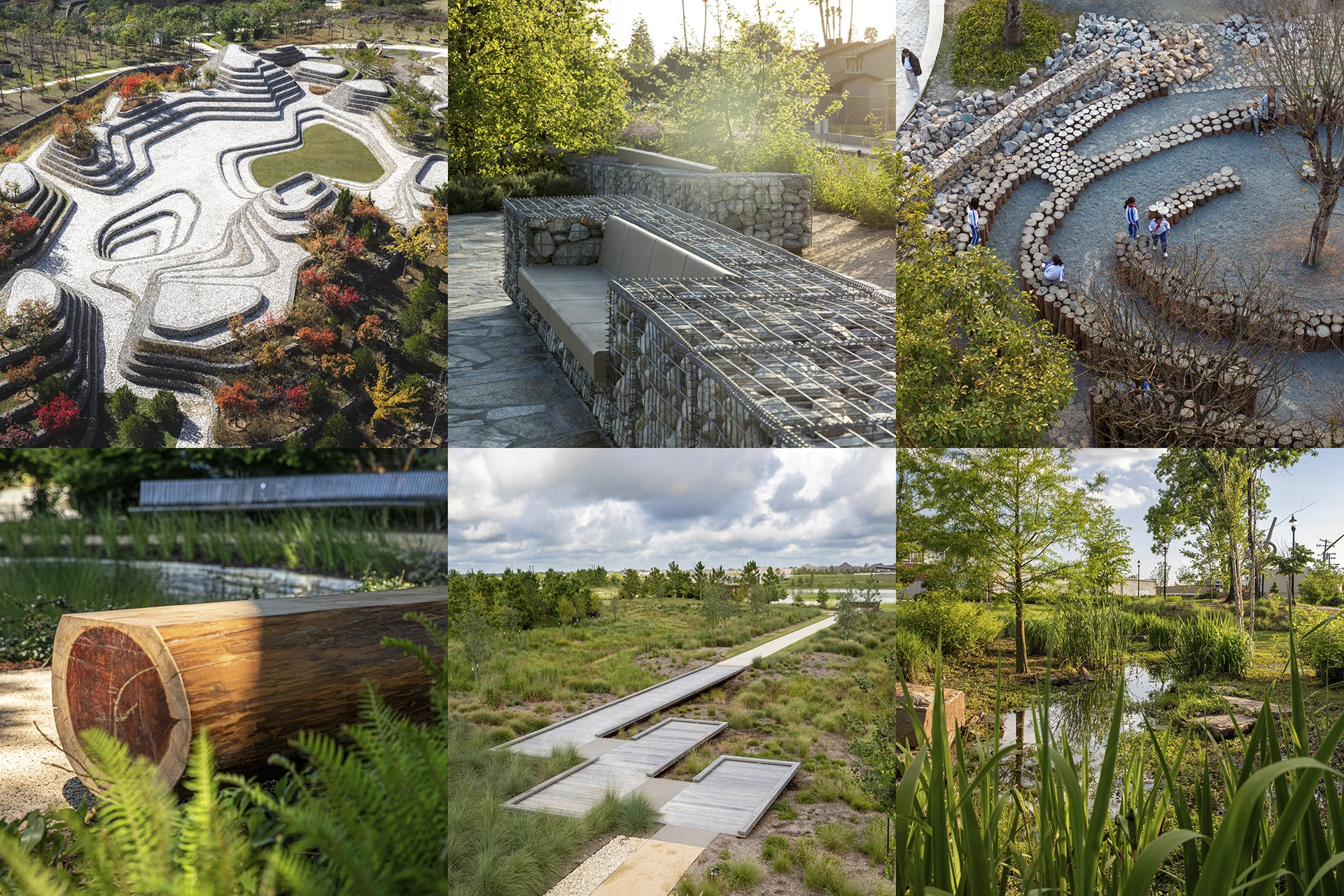
It’s a deceptively simple question. Unlike stone, plants, and manufactured materials that typically define designed landscapes, emissions are invisible, their impacts embedded in supply chains, construction practices, and maintenance. But as urgency mounts to decarbonize the built environment, today’s designers face a new set of questions around the aesthetics of low-carbon design.
How can we recognize low-carbon strategies in public space? How might carbon-conscious values shape new visual and experiential qualities in our landscapes? Beneath these questions lies a deeper concern: Will designing for carbon come at the expense of creative expression or beauty itself?
Landscape architecture has faced this question before. For much of the last century, the discipline wrestled with trade-offs—both real and perceived—between aesthetics and performance. Modernist landscapes privileged clarity and formal legibility through restrained palettes, industrial materials, and geometric forms. By the late twentieth century, ecological design reframed performance itself as an aesthetic project, as landscapes supporting biodiversity and visible natural processes came to express emergent cultural values.
That shift reshaped expectations for public landscapes in the span of a single generation. Thirty years ago, replacing turf lawns with native grasses was controversial, seasonal dormancy read as neglect, and “messiness” signaled failure. Today, meadows, rain gardens, bioswales, and heterogeneous plant communities have become visual shorthand for environmental responsibility.
Now, as landscape architects turn toward decarbonization, a similar recalibration is underway. The question is no longer whether carbon will influence design, but how its values will register in the landscapes we build—through decisions about materials, scale, and maintenance.
Signals from the Field
One way the low-carbon aesthetic is beginning to take shape is through a more visible embrace of material reuse. Once framed mainly as a cost-saving measure, reuse carries growing aesthetic weight. When materials are salvaged, repurposed, and left legible, they reveal connections to history, memory, and place.
In this sense, reuse reconnects contemporary practice to a long-standing idea in landscape architecture: that meaningful design emerges from close attention to genius loci—the particular qualities of a landscape shaped by its geography, climate, materials, and patterns of human use over time. Because carbon is closely tied to sourcing and transport, designing for decarbonization naturally shifts attention toward what is local, available, and already present. Reuse-oriented landscapes foreground material histories rather than erasing them, cultivating an aesthetic rooted in continuity, specificity, and care.
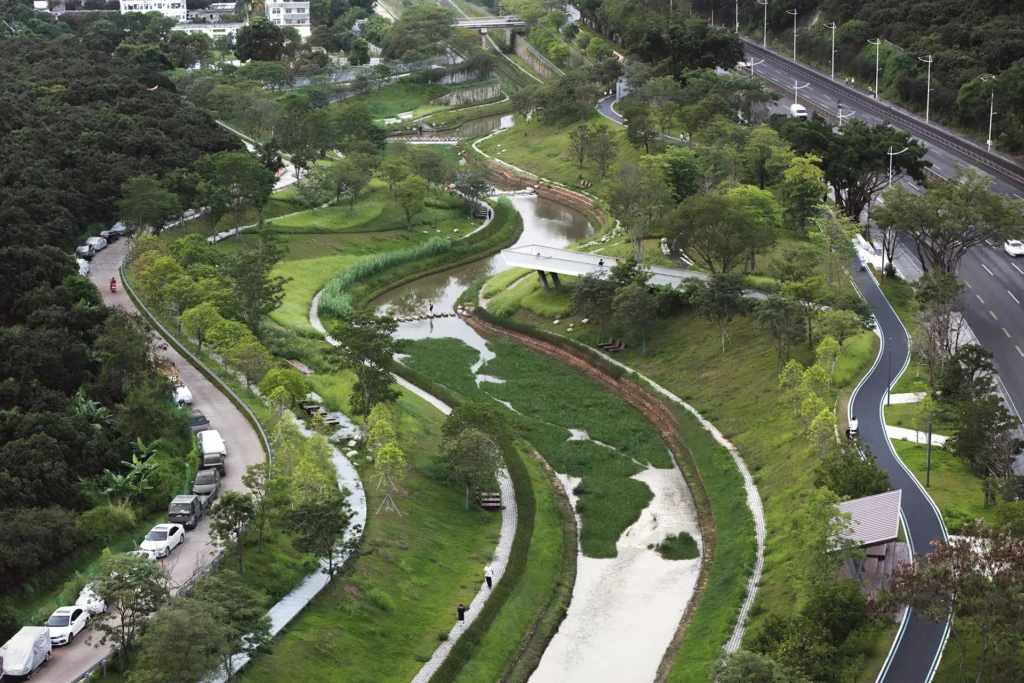
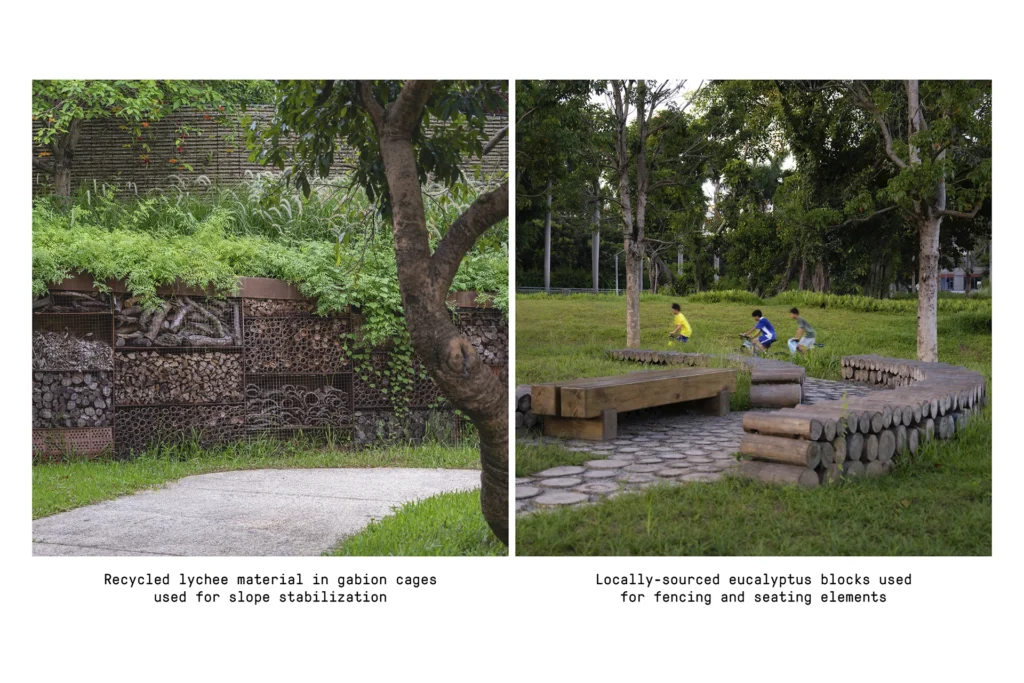
Xili Lake Greenway
Shenzhen, China
At Xili Lake Greenway, materials generated by nearby lychee orchards—including pruned branches, pine cones, and reclaimed bricks—were assembled into a series of insect-habitat gabions integrated along the greenway. Built largely from materials sourced on or near the site, the structures reduce transport emissions while providing nesting space for insects; monitoring showed colonization within weeks. The largest installation, measuring 36 meters long and 3 meters high, is now considered China’s largest insect habitat of its kind, while eucalyptus logs harvested on-site were repurposed as seating and play elements.
Learn more about Xili Lake Greenway.
Another emerging signal is a renewed emphasis on restraint, not as a return to modernist minimalism, but as an ethic of sufficiency. Twentieth-century public landscapes often followed an over-engineered logic inherited from post-war development: broad roadways, expansive plazas, oversized retaining structures, and redundant systems that signaled permanence and civic ambition.
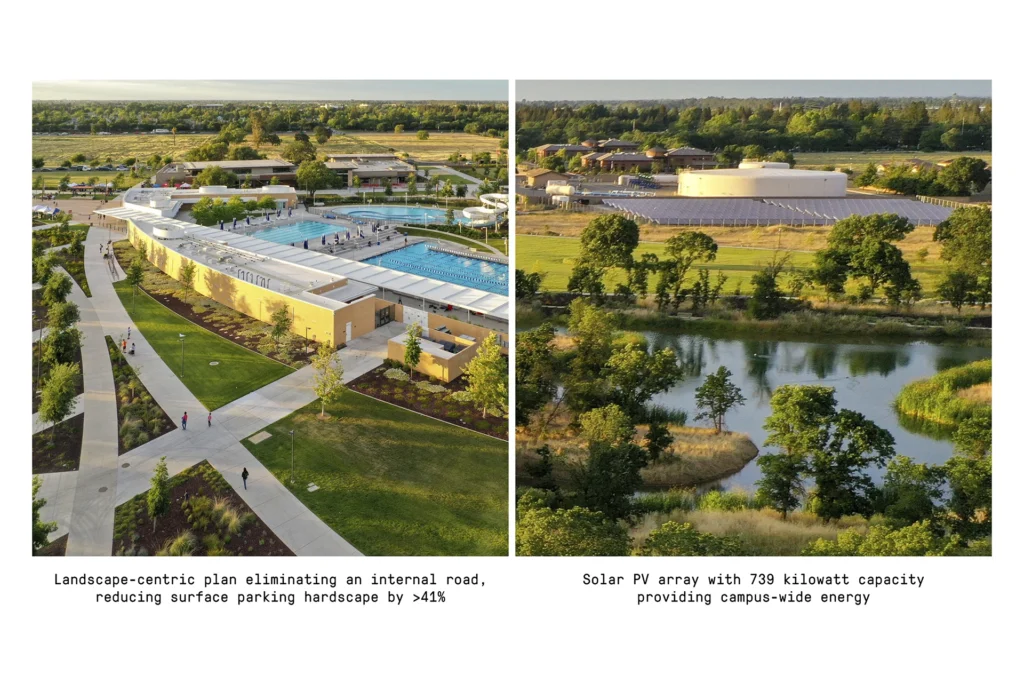
In a decarbonization context, that logic shifts. “Right-sizing” reads less as a compromise than as a conscious stance. Lighter structures, narrower paths, reduced hardscape, and more planted ground lower embodied carbon while signaling care, responsibility, and a changing understanding of public investment.
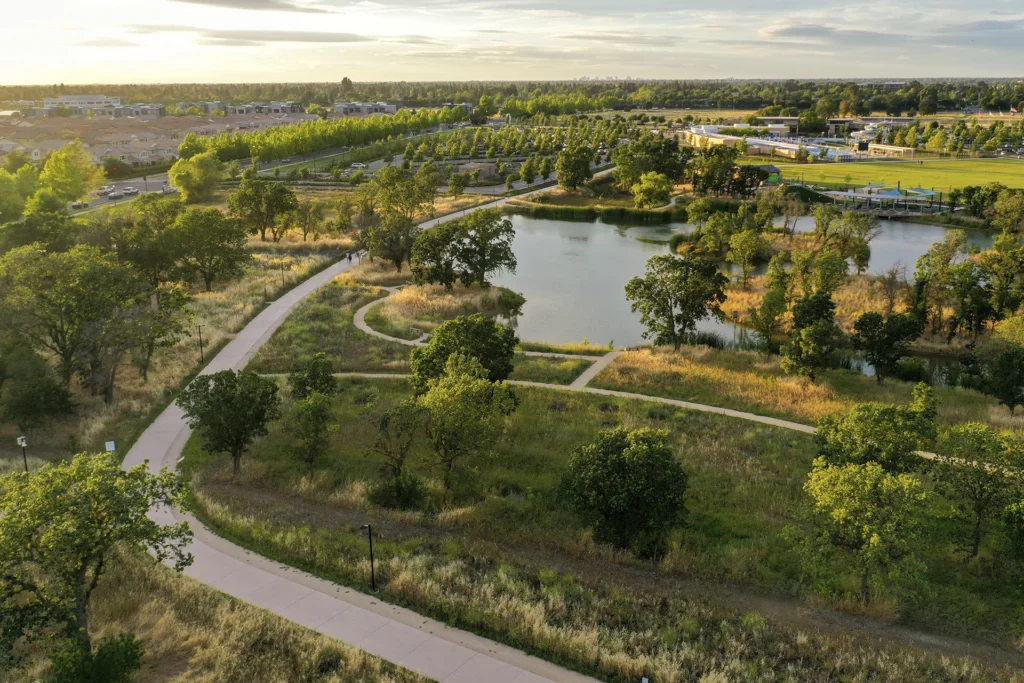
Elk Grove Civic Center
Elk Grove, CA
Earlier plans for Elk Grove’s civic center centered on an internal roadway and extensive paved circulation. The built project eliminated that road, consolidated parking, and reduced lane widths and internal paving, cutting hardscape associated with surface parking by more than 41 percent. Fewer paved acres lowered embodied carbon while freeing space for planting, tree canopy, and stormwater systems, supported by a 739-kilowatt photovoltaic array designed to power the campus.
Learn more about Elk Grove Civic Center.
The low-carbon aesthetic is also emerging through the expanding market for alternative building materials. Nearly 80 percent of emissions associated with landscape projects come from materials like concrete, steel, wood, and rubber. As lower-carbon alternatives become available, material choice itself is becoming a place where evolving values around responsibility, restraint, and care surface in design.
This is not the first time shifts in material production reshaped the built environment. After World War II, industrial manufacturing transformed landscapes and cities as concrete, steel, and synthetic materials came to symbolize progress and permanence. Today, a quieter transition is underway. Low-carbon concrete mixes, alternative wood products, bio-derived surfaces, recycled aggregates, and modular assemblies are entering the mainstream, often designed to perform and appear much like their higher-carbon predecessors.
Over time, that may change. Variations once treated as imperfections—differences in texture, color, or finish—may come to signal environmental responsibility rather than compromise, communicating where materials come from, how they perform, and what they leave behind.
Lynwood Mega Playground
Lynwood, CA
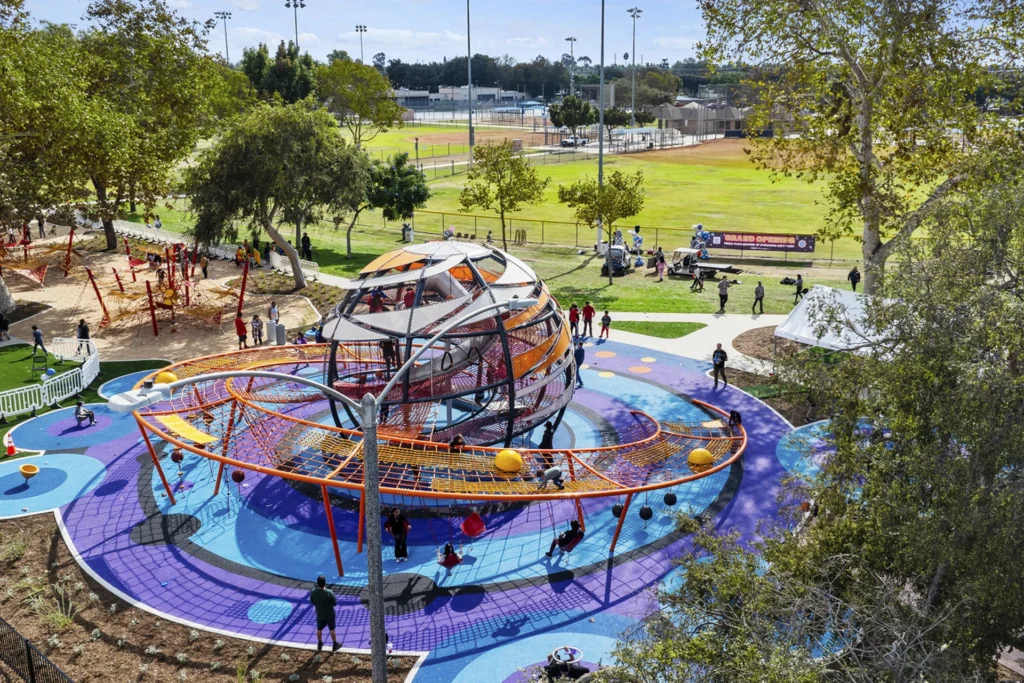
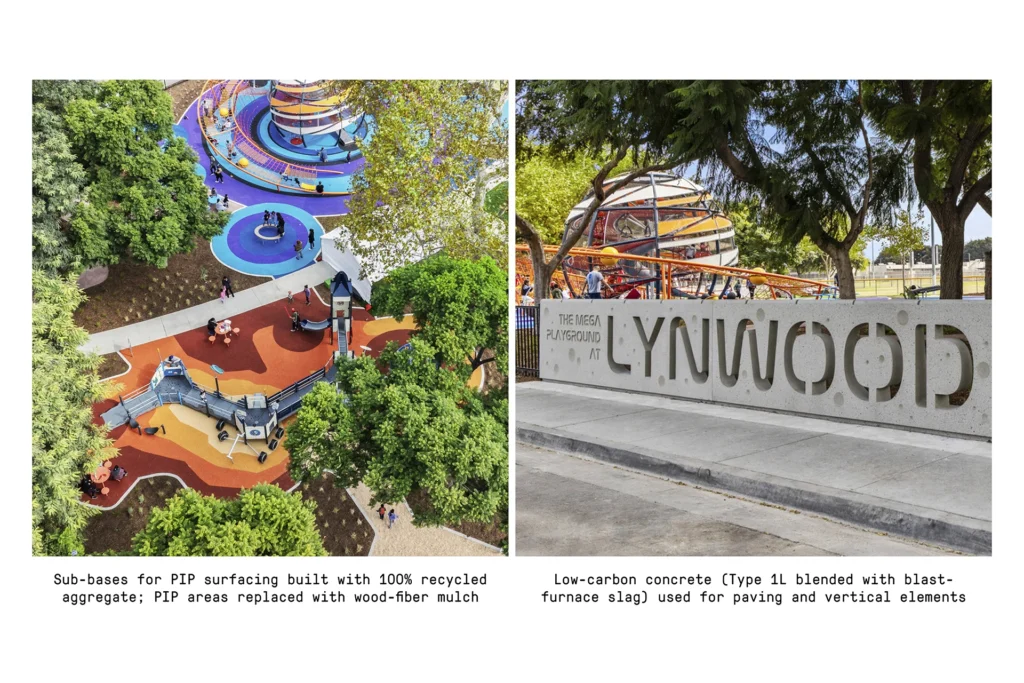
Playgrounds offer a particularly revealing context for low-carbon material experimentation. At Lynwood Mega Playground, embodied carbon was reduced through targeted material substitutions within a high-use play environment. Low-carbon concrete made with Type 1L cement and blast-furnace slag was used for paving and vertical elements, while portions of the pour-in-place rubber surfacing were replaced with wood-fiber mulch. All PIP sub-bases were constructed with 100 percent recycled aggregate. These changes maintained standard performance, safety, and cost while lowering the project’s overall carbon footprint.
Learn more about Lynwood Mega Playground.
A Defining Moment
Landscape architecture has always evolved in response to constraints. Modernism emerged alongside industrialization and material scarcity; ecological design followed as environmental degradation revealed landscapes as living systems. Each shift carried anxiety that something essential to the discipline might be lost in the name of performance or progress.
We’re now at another inflection point and familiar questions are resurfacing. Will low-carbon landscapes feel overly restrained? Will they lack refinement or expressiveness? Will performance come at the expense of beauty? In hindsight, these concerns often mark periods of transition, when aesthetic expectations begin shifting alongside new values.
So what does the low-carbon landscape look like? Because carbon itself remains largely invisible, its aesthetic expression is still unsettled. That uncertainty offers latitude. Through decisions about sourcing, materiality, scale, and finish, designers are beginning to shape the outlines through everyday design decisions rather than singular stylistic gestures. What comes next will not be dictated by carbon alone, but by how the discipline chooses to interpret its implications. The next aesthetic chapter of landscape architecture is already underway, and its shape is still very much up for design.
Read about SWA’s first full year of implementing its Climate Action Plan, featuring eight project case studies. Learn more here.